
A Day Inside a Frozen Mackerel Processing Factory
Introduction
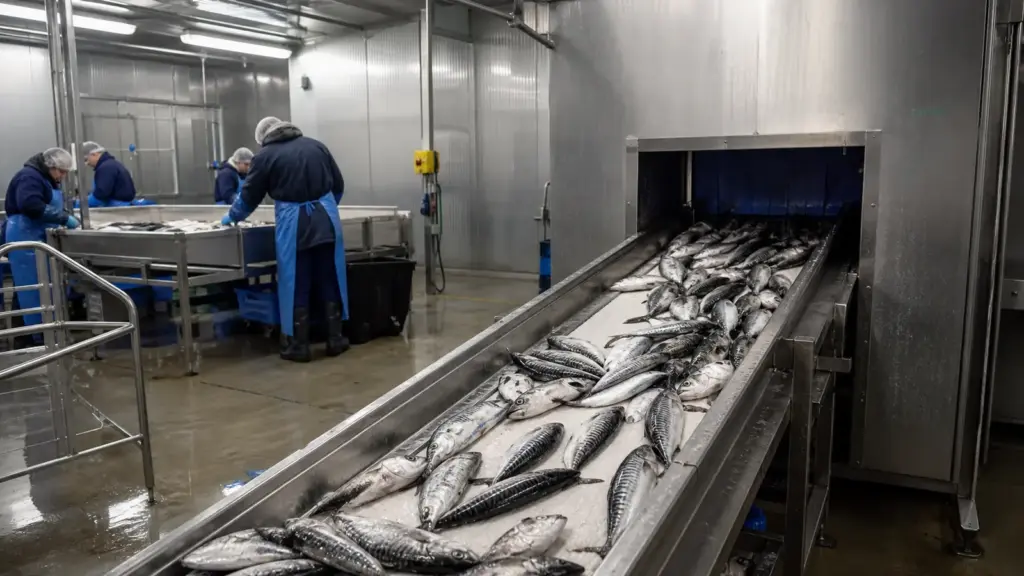
Frozen Mackerel Factory Production is organized around time, temperature, line capacity, and the requirements of each export order. A typical day may involve several raw-material lots, size grades, packaging designs, and shipment deadlines. The factory must keep them separated while maintaining hygiene and preventing delays before freezing. The following schedule is a representative industry example rather than a description of Hanxing Seafood’s own facility. Importers can use it as an audit framework and compare order requirements with the public data on Hanxing’s Pacific mackerel product page.
Table of Contents
- Frozen Mackerel Factory Production Before the Shift
- Receiving Window: Raw Material Arrives
- Start-Up Checks and First Product
- Mid-Morning: Grading and Process Control
- Freezer Loading: Capacity Sets the Pace
- Afternoon: Glazing, Weighing, and Packing
- Quality Inspection During the Shift
- Finished Goods Move to Cold Storage
- End of Production: Reconciliation and Records
- Sanitation After the Shift
- What a Buyer Should Observe During a Visit
- Conclusion
Frozen Mackerel Factory Production Before the Shift
The production day begins with a plan prepared from confirmed orders, raw-material availability, packaging stock, freezer capacity, and cold-store space. Supervisors review the product form, size grade, carton code, label, net weight, and expected yield for each batch. Quality staff confirm that the line has been cleaned and released, measuring devices are available, and previous products or labels have been removed. Maintenance teams check conveyors, scales, freezers, water, ice, and backup systems. A short pre-shift meeting assigns responsibilities and reviews food-safety risks. This preparation is essential because correcting a label or carton error after freezing can require expensive rework.
Receiving Window: Raw Material Arrives
Deliveries are scheduled so the factory does not receive more fish than it can inspect and process. Receiving personnel check the vehicle, documents, species, source, quantity, condition, and temperature. Mackerel requires careful time-temperature control because of histamine risk. The FDA seafood HACCP and hazard-control guidance helps processors identify relevant hazards and controls. Accepted lots receive unique codes; questionable lots are held for evaluation, and rejected lots should remain physically controlled. The buyer should be able to see how receiving records connect to finished cartons rather than relying on a general statement that traceability exists.
Start-Up Checks and First Product
When the first fish reaches the line, quality staff often perform more frequent checks. They confirm size, processing form, appearance, washing, trimming, and line speed. If the product is whole round, workers sort and arrange fish with minimal handling. If the order requires gutting or scaling, the team checks cut quality and cleanliness. The FAO information on mackerel handling and processing provides useful technical background on preserving quality. The first completed pack or block should be reviewed against the approved specification before full-rate production begins. A ten-minute correction at start-up can prevent hundreds of incorrect cartons.
Mid-Morning: Grading and Process Control
As the line reaches normal speed, supervisors balance incoming flow with grading, processing, and freezer loading. Grading staff remove fish outside the size tolerance and separate defects. Production records should show the input lot, output grade, rejected quantity, and yield. Buyers should understand whether the quoted size is a strict piece-weight band, an average, or a market count grade. If multiple grades are produced simultaneously, color-coded bins, signs, or dedicated line positions can reduce mixing. Quality staff sample at defined intervals rather than only at the beginning and end of the shift.
Freezer Loading: Capacity Sets the Pace
The freezer is often the production bottleneck. If the processing line runs faster than the freezer can accept product, semi-finished fish may wait and warm. The FAO guidance on fish freezing operations stresses rapid freezing and process monitoring. Operators load trays, belts, plates, or blocks in a consistent pattern and record time, equipment settings, and batch identity. Product thickness and arrangement influence the freezing cycle. When the cycle is complete, staff verify the required condition before release to glazing or packing. Under-frozen fish can deform, stick, lose glaze, or create temperature problems in the cold store.
Afternoon: Glazing, Weighing, and Packing
Frozen product moves through glazing where specified, then weighing and packing. Glaze should cover the surface evenly without hiding damage or creating an inaccurate net weight. Scales need routine checks, and the team should record results for each line and product. Packers use the approved inner bag, carton, tape, straps, and markings. A line-clearance check is important when changing from one customer’s carton to another. Importers should request a photo of the first finished carton, including all sides and the label, before the lot is completed. Hanxing’s products page can help buyers identify the species and size information to include in a quotation request, but final packaging must be confirmed order by order.
Quality Inspection During the Shift
Quality control is continuous, not a final ceremony. Inspectors may check piece weight, size distribution, processing defects, net weight, glaze, carton condition, label accuracy, product temperature, and sensory condition after thawing. Testing frequency should be based on risk and lot size. Results outside limits require immediate action: stop the line, isolate affected product, adjust equipment, retrain workers, or regrade the lot. Records should show both the deviation and the correction. Buyers reviewing a factory should ask for examples of real corrective-action records, because a file containing only perfect results may not reflect normal operations.
Finished Goods Move to Cold Storage
Packed cartons should move quickly into frozen storage and be scanned or recorded into an inventory location. The warehouse verifies quantity, lot code, production date, and order allocation. Cartons should be stacked to prevent crushing and preserve airflow around storage equipment. Product that is on hold for test results must be electronically or physically blocked from shipment. The cold-store team prepares future picks by container, reducing search time during loading. Hanxing’s About Us page provides the company’s published business profile, while buyers should request order-specific confirmation of finished quantity, production date, and readiness before arranging final payment or shipment.
End of Production: Reconciliation and Records
At the end of a batch or shift, production, quality, and warehouse teams reconcile raw-material input, finished output, rejects, rework, packaging use, and inventory. Large unexplained differences may signal weighing errors, unrecorded transfers, or traceability gaps. Supervisors review whether the planned quantity was achieved and whether any cartons remain incomplete. Documents may include receiving logs, process checks, freezer records, weight checks, label verification, sanitation checks, maintenance notes, nonconformity reports, and cold-store entry. These records should be retained according to legal and customer requirements and be retrievable by lot.
Sanitation After the Shift
Once product leaves the line, sanitation teams remove waste, dismantle designated equipment, clean, rinse, sanitize, and inspect food-contact surfaces. Cleaning tools should be controlled by area to prevent cross-contamination. Drains, floors, knives, belts, tables, and hard-to-reach equipment parts deserve attention. The next shift should not start until pre-operational inspection confirms acceptable conditions. Water accumulation, damaged surfaces, condensation, and recurring residue can reveal design or maintenance problems. During an audit, buyers should visit both during production and after cleaning when possible; the two views show whether hygiene systems are practical rather than only visually prepared for guests.
What a Buyer Should Observe During a Visit
A useful visit follows the product, not the sales presentation. Observe receiving, worker flow, raw and finished product separation, time before freezing, grading accuracy, temperature measurements, carton control, and cold-store lot identification. Ask operators simple questions about what they do when a result is out of specification. Compare spoken answers with written procedures and records. Note whether employees understand their tasks and whether supervisors react calmly to normal production variation. Finally, request an order-specific process plan before purchase. The objective is to determine whether the daily system can repeatedly produce the agreed product, not whether the factory looks impressive for one hour.
Conclusion
A frozen mackerel factory day is a controlled sequence of planning, receiving, grading, processing, freezing, weighing, packing, inspection, storage, reconciliation, and sanitation. Capacity must be balanced at every stage so that product does not wait or lose temperature control. Importers who understand Frozen Mackerel Factory Production can design better specifications, select meaningful audit checkpoints, and request evidence at the times when errors are easiest to prevent. The most reliable factories are not those that never encounter variation; they are those that detect, isolate, correct, and document it before shipment.
Request a Quote
For a quotation based on your market’s required size, processing form, packing, and destination, contact Hanxing Seafood with the complete order details.
Looking for a Frozen Seafood Supplier?
Contact HANXING SEAFOOD to confirm current availability, specifications, packing, and quotation details.
Request a Quote