
From Catch to Export: The Complete Frozen Mackerel Supply Chain
Introduction
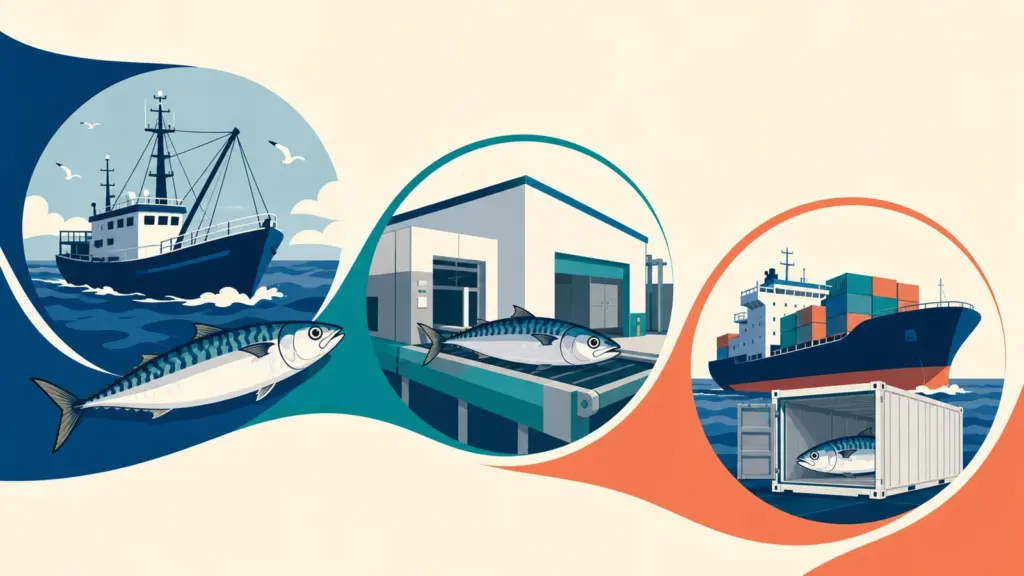
The Frozen Mackerel Supply Chain is a sequence of temperature-sensitive handovers rather than a single factory operation. Product quality can be affected on the vessel, at landing, during raw-material transport, inside the processing plant, in the freezer, in cold storage, during container loading, at the port, and after arrival. Each participant may perform its task correctly while the overall chain still fails because records, responsibilities, or timing are disconnected. This guide follows the commercial flow from catch to export and shows where importers should request evidence. For a current product reference, buyers can review Hanxing Seafood’s Pacific mackerel specifications.
Table of Contents
- Frozen Mackerel Supply Chain Begins at Harvest
- Landing, Auction, and Raw-Material Transfer
- Receiving and Production Scheduling
- Processing, Grading, and Product Definition
- Freezing as a Quality-Preservation Step
- Cold Storage, Stock Rotation, and Lot Integrity
- Sales Contract and Export Documentation
- Reefer Container Preparation and Loading
- Port, Vessel, and Transshipment Risk
- Arrival, Inspection, and Claims Management
- Building Resilience Across the Chain
- Conclusion
Frozen Mackerel Supply Chain Begins at Harvest
The chain begins when mackerel is caught. Harvest method, trip length, onboard handling, crowding, physical damage, and chilling speed influence the condition delivered to the processor. Mackerel can form histamine when exposed to unsuitable time and temperature conditions, so control must start before the factory receives the fish. The FDA seafood hazards and controls guidance provides a recognized framework for identifying species- and process-related hazards. Importers do not normally manage vessels directly, but they can require the processor to maintain approved-supplier procedures, harvest or receiving records, temperature checks, and rejection criteria. A low price cannot compensate for raw material that has already deteriorated.
Landing, Auction, and Raw-Material Transfer
After landing, the fish may pass through a landing center, auction, collector, trader, or direct delivery arrangement. Every transfer creates a risk of delay, warming, lot mixing, and incomplete traceability. A strong supply chain records the vessel or supplier, landing date, source area where required, quantity, temperature, and receiving decision. Refrigerated vehicles or insulated containers should be clean, suitable for food, and loaded to protect the fish from contamination and compression. Buyers should ask how many intermediaries are involved and whether the processor can trace a finished carton back to an identifiable raw-material lot. Fewer intermediaries can simplify control, but documented control is more important than a simple chain on paper.
Receiving and Production Scheduling
The processing factory checks the raw material and decides whether it is suitable for the intended product. Production planning should match the volume received with labor, line speed, freezer capacity, packaging, and cold-store space. If too much fish enters the plant without enough freezing capacity, waiting time can increase and quality can decline. A disciplined factory schedules batches, sets maximum processing times, and maintains separation between accepted, held, and rejected material. Importers should request the product flow and critical control points rather than a generic statement that the plant “uses HACCP.” The plan should be relevant to the specific mackerel product and destination market.
Processing, Grading, and Product Definition
Mackerel may be exported whole round, headed and gutted, gutted and scaled, cut, or further processed. It may be individually frozen or block frozen, with different market preferences for size and packing. Grading converts variable biological raw material into commercial units. The buyer’s specification should define piece-weight bands, tolerances, damaged-fish limits, processing defects, net weight, glaze, packing, and label requirements. When these terms are unclear, the factory may produce a lot that is internally consistent but commercially unsuitable for the buyer’s customers. Hanxing’s frozen seafood product range demonstrates the breadth of species and size categories that can appear in export trade, reinforcing the need for exact order descriptions.
Freezing as a Quality-Preservation Step
Freezing does not improve poor raw material; it slows further deterioration when applied correctly. The FAO fish freezing and cold-chain guidance emphasizes rapid freezing and monitoring of the process. Equipment may include air-blast, contact plate, tunnel, spiral, or block freezers depending on product form. The factory should control loading, spacing, time, and product core condition. After freezing, exposed product should move promptly to glazing or packing and then to frozen storage. Importers can request freezer records, calibration evidence, and finished-product temperature checks, especially when qualifying a new facility or investigating texture, dehydration, or rancidity complaints.
Cold Storage, Stock Rotation, and Lot Integrity
Cold storage is an active control system, not a passive warehouse. Cartons must remain identifiable, protected from damage, and stored under stable frozen conditions. The warehouse management system may be digital or manual, but it should show lot, quantity, production date, location, status, and allocation to orders. First-expired-first-out is generally more useful than simple first-in-first-out when shelf-life dates differ. Buyers should ask how the cold store handles temperature alarms, door opening, defrost cycles, backup power, damaged cartons, and stock discrepancies. Hanxing’s About Us page publishes its company profile; however, order-specific inventory status and storage location should be confirmed separately in writing.
Sales Contract and Export Documentation
Commercial documents translate the physical product into a legally importable shipment. Depending on the transaction and destination, the document set may include the contract, commercial invoice, packing list, bill of lading, certificate of origin, health certificate, catch or traceability documentation, insurance certificate, inspection report, and other permits. Names, weights, container numbers, seals, dates, and product descriptions must be consistent. A documentation error can delay clearance even when product quality is acceptable. Buyers should approve drafts early and assign responsibility for each document. Payment terms should be linked to clearly defined milestones rather than vague phrases such as “after documents are ready.”
Reefer Container Preparation and Loading
Before loading, the reefer container should pass the carrier’s pre-trip process and be clean, odor-free, structurally sound, and set to the agreed temperature. Product and container should already be cold; a reefer is designed mainly to maintain temperature, not to freeze warm cargo. The FAO guidance on transporting frozen fish recommends pre-cooling and rapid loading to limit temperature rise. Cartons should be arranged to maintain airflow and avoid blocking the required channels. The loading team records container and seal numbers, loading quantity, start and finish time, product temperature checks, and photographs. These records become important evidence if a claim occurs.
Port, Vessel, and Transshipment Risk
At the port, the container depends on terminal plug power, customs release, vessel schedule, and carrier handling. Direct services can reduce handovers, but transshipment may be unavoidable for many destinations. A longer route does not automatically mean poor quality if the reefer operates correctly, yet it increases exposure to delay, power interruption, and schedule changes. Importers should compare total transit time, transshipment port performance, free-time terms, demurrage risk, and destination plug availability. Shipping instructions and verified gross mass should be submitted on time. The seller and buyer should also agree who monitors the shipment and how exceptions are communicated.
Arrival, Inspection, and Claims Management
The supply chain continues after the vessel arrives. The importer coordinates customs, health inspection where required, terminal release, refrigerated transport, and receiving at the cold store. Container set point, download data where available, seal condition, carton condition, and product temperature should be recorded before cargo is widely distributed. If a problem is found, the importer should preserve evidence, notify the insurer and contractual parties, and avoid actions that destroy traceability. A claim should distinguish between manufacturing defects, temperature abuse, transit damage, weight shortage, documentation failure, and market dissatisfaction. Each has different evidence and responsibility.
Building Resilience Across the Chain
A resilient supply chain has approved alternatives for raw material, processing, cold storage, port routing, and shipping lines. It also uses realistic lead times and buffer stock. Importers can reduce risk by forecasting demand, sharing packaging requirements early, standardizing inspection criteria, and maintaining a second qualified supplier. Suppliers can improve reliability by reserving freezer and cold-store capacity, monitoring vessel schedules, and communicating shortages before production. Hanxing’s global frozen seafood market trends discuss the importance of lead times and supply-chain planning in changing market conditions.
Conclusion
The frozen mackerel journey from catch to export is only as strong as its weakest handover. Harvest control, receiving, processing, freezing, storage, documentation, reefer loading, port handling, and destination receipt must all preserve product identity and temperature. Importers should therefore evaluate the complete Frozen Mackerel Supply Chain rather than judging a supplier only by factory photos or price. Written specifications, lot traceability, temperature evidence, document accuracy, and clear claim procedures turn a complex chain into a manageable commercial system.
Request a Quote
For pricing and an order-specific discussion, contact Hanxing Seafood with your target mackerel specification, packing, quantity, Incoterm, and destination port.
Looking for a Frozen Seafood Supplier?
Contact HANXING SEAFOOD to confirm current availability, specifications, packing, and quotation details.
Request a Quote