
How a China Frozen Mackerel Export Factory Processes Orders
Introduction
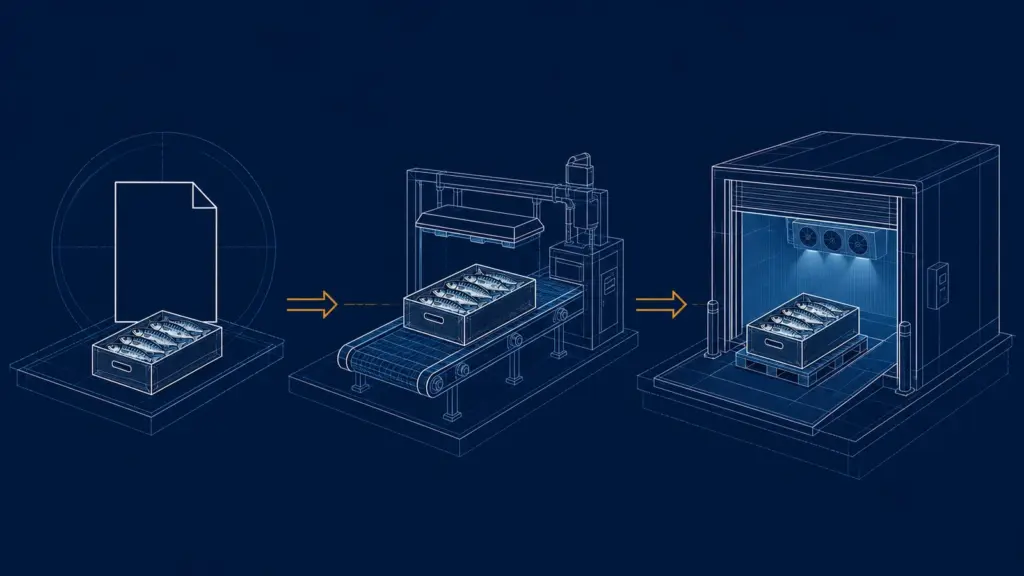
The China Frozen Mackerel Factory Process usually begins well before fish enters the production room. Export orders require a confirmed species, origin, size grade, processing form, net-weight basis, packing, label, destination standard, and shipment schedule. A professional factory translates these commercial requirements into a production instruction and lot-control plan. The sequence described below is a general industry workflow, not a statement about any specific company’s facilities. Buyers reviewing a live offer can compare the required information with Hanxing Seafood’s public frozen Pacific mackerel specifications and request written confirmation for the actual lot.
Table of Contents
- China Frozen Mackerel Factory Process: Order Review
- Raw-Material Receiving and Lot Identification
- Thawing or Direct Processing
- Sorting and Size Grading
- Primary Processing and Washing
- Freezing the Product
- Glazing, Weighing, and Net-Weight Control
- Packing, Labeling, and Carton Integrity
- Finished-Product Inspection and Release
- Cold Storage and Export Handover
- Buyer Control Points for a New Supplier
- Conclusion
China Frozen Mackerel Factory Process: Order Review
Production should not begin from a short message such as “one container of mackerel.” The sales contract or specification sheet should define the accepted species, size range, whole round or processed form, IQF or block freezing, glazing if applicable, gross and net weight, carton construction, markings, shelf life, and inspection standard. The factory planning team then checks raw-material availability, freezer capacity, packaging stock, labor, cold-store space, and vessel cut-off. Label artwork should be approved before printing, especially when the destination requires local-language names, importer details, production dates, lot codes, storage instructions, or establishment numbers. Clear order review prevents costly rework after production.
Raw-Material Receiving and Lot Identification
At receiving, staff should verify supplier documents, species identity, source, quantity, condition, and temperature. Each delivery should receive a lot code that remains linked to production and finished goods. Mackerel is an oily, histamine-forming fish, so time and temperature control is a major safety and quality issue. The FDA Fish and Fishery Products Hazards and Controls Guidance is a useful reference for hazard analysis and control strategies, although each destination market has its own legal requirements. Receiving decisions may include acceptance, segregation, additional testing, or rejection. Buyers should ask what records are created and how the factory prevents unapproved raw material from entering production.
Thawing or Direct Processing
Some factories process freshly landed or chilled fish, while others may use frozen raw material that requires controlled tempering or thawing. The method affects texture, drip loss, production time, and food-safety controls. Thawing should occur under defined time-temperature conditions with drainage and protection from contamination. Product should not be left at ambient temperature simply to accelerate the line. If the order is for whole round frozen mackerel and the raw material is suitable, the handling sequence may be shorter. If headed, gutted, scaled, or cut forms are required, the factory needs additional trimming, washing, inspection, and yield control. The contract should clarify whether the product is single frozen or has undergone more than one freezing cycle.
Sorting and Size Grading
Mackerel is commonly traded by piece-weight bands or count-related commercial grades. Grading can be manual, mechanical, or a combination of both. The objective is not merely to create an average; each carton should meet the agreed tolerance. Factories normally remove damaged, soft, discolored, dehydrated, or otherwise nonconforming fish during sorting. Buyers should define whether the size is measured before or after glazing, whether mixed sizes are permitted, and how many samples are checked per lot. Hanxing’s product range shows that frozen seafood products can be offered in multiple commercial size bands, but the buyer must confirm which band is available for the production period and how grading accuracy will be verified.
Primary Processing and Washing
For whole round product, primary processing may consist mainly of sorting, washing, and arranging fish for freezing. For gutted or scaled product, workers remove specified parts while minimizing belly damage and contamination. Knives, tables, conveyors, water, ice, and employee hygiene must be controlled. The FAO technical note on handling and processing mackerel provides background on the species and common processing considerations. Buyers should focus on measurable outcomes: clean cuts, complete removal as specified, limited blood staining, no foreign material, and consistent appearance. Processing speed should be matched to freezer capacity so semi-finished fish does not wait unnecessarily.
Freezing the Product
The freezing stage is central to product quality. The FAO states in its FAO guidance for freezing fish products that fish should be frozen as quickly as practicable because delays raise product temperature and accelerate quality deterioration. Depending on product form and equipment, factories may use individual quick freezing, contact plate freezing, air-blast freezing, or block freezing. The important controls include loading pattern, product thickness, freezer temperature, time, and confirmation that the required core condition has been reached. A buyer should ask how the factory validates freezing cycles and prevents under-frozen product from being packed.
Glazing, Weighing, and Net-Weight Control
Glazing can protect frozen fish from dehydration and oxidation when correctly applied. It must not be used to disguise low net weight or unstable product temperature. The production specification should state whether weight is net of glaze, the permitted glaze range if applicable, and the testing method. After freezing and glazing, product is weighed for each pack or carton. Automatic checkweighers may be used, but manual verification and calibration records remain important. Buyers should define tolerances and whether drained or deglazed net weight will be tested at destination. Repeated underweight cartons create commercial claims even when the fish itself is acceptable.
Packing, Labeling, and Carton Integrity
Frozen mackerel may be packed in polybags, master cartons, blocks, or other market-specific formats. Cartons should be strong enough for cold-store stacking, container loading, long sea transit, and handling at destination. Printing must match the approved artwork, and lot codes should be legible and traceable. Inner liners or bags should be food-grade and properly closed. During packing, workers should prevent mixed lots, mixed sizes, damaged cartons, and warming of exposed product. Importers should request pre-production carton photos, final pallet or floor-load photos, and label close-ups. Hanxing’s About Us page can be checked for the company’s published service profile, but the exact packaging for an order should always be confirmed in the quotation and contract.
Finished-Product Inspection and Release
A finished lot should be inspected against the purchase specification before release. Checks may cover species, size, count, processing quality, appearance, odor after thawing, net weight, glaze, carton markings, temperature, and microbiological or chemical testing where required. The sampling plan must be realistic for the lot size. One attractive carton selected by the sales team is not representative evidence. Some buyers use independent inspection companies to select random cartons, witness loading, and issue a report. Any nonconformity should be documented with a decision to regrade, rework, hold, accept under concession, or reject. Release authority should be separated from production pressure whenever possible.
Cold Storage and Export Handover
Released cartons move to frozen storage under controlled conditions until container loading. The cold store should maintain lot separation, stock records, and an order-picking plan. Before dispatch, the factory or logistics team confirms booking, container number, seal, set point, pre-trip inspection status, loading time, documents, and transport to port. Product should be loaded quickly to limit temperature rise. The exporter then coordinates customs declaration and shipment documents according to the contract and destination requirements. For buyers, the factory process is complete only when the product, records, container, and documents all correspond to the same approved lot.
Buyer Control Points for a New Supplier
A new buyer should request a process flow diagram, factory approval evidence, sample specification, recent product photos, and a draft label before paying. During production, useful checkpoints include raw-material arrival, size-grading results, first packed carton, mid-production net-weight checks, final lot summary, and container loading. A pre-shipment sample can help, but it must be linked to the production lot. Buyers should also agree on claim handling, document deadlines, and the party responsible for corrective costs. Hanxing’s contact page provides a direct route to request order-specific information rather than relying on assumptions from a general website page.
Conclusion
A frozen mackerel export order is the result of coordinated commercial, technical, and logistics controls. The typical sequence covers order review, receiving, traceability, thawing where needed, grading, processing, freezing, glazing, weighing, packing, inspection, storage, and export handover. The most important lesson for importers is that every step should connect to a written specification and a traceable lot. Understanding the China Frozen Mackerel Factory Process helps buyers ask precise questions, plan inspections, and evaluate whether a supplier can consistently deliver the agreed product rather than only provide a competitive quotation.
Request a Quote
For a current quotation, send your required species, size, processing form, freezing method, packing, quantity, and destination port to Hanxing Seafood’s sales contact.
Looking for a Frozen Seafood Supplier?
Contact HANXING SEAFOOD to confirm current availability, specifications, packing, and quotation details.
Request a Quote