
Major Mackerel Origins Compared: How Producing Regions Stack Up for Global Buyers
Introduction
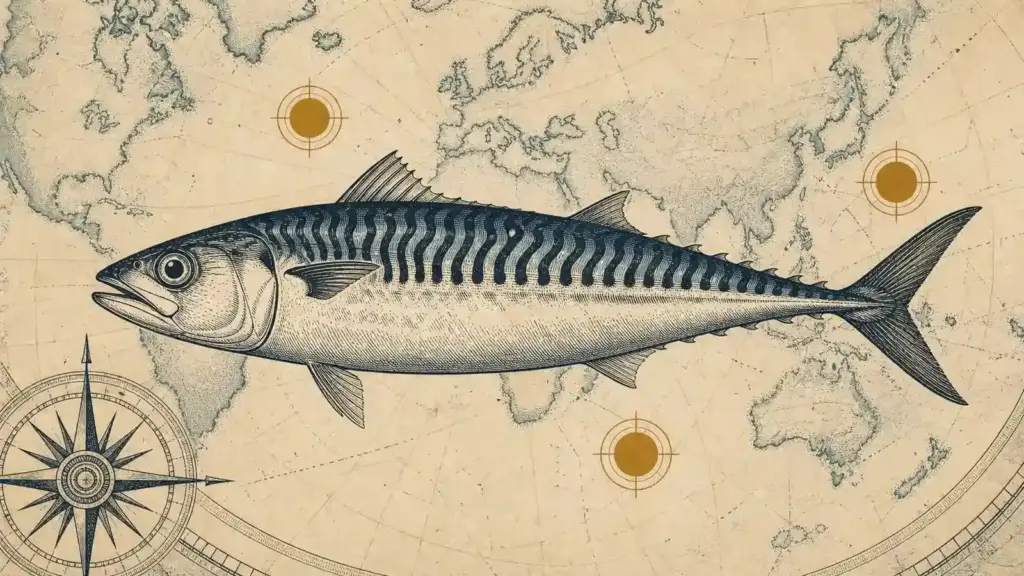
Mackerel ranks among the most heavily traded pelagic species in global seafood, with annual landings exceeding five million metric tons. For B2B importers and processors, the choice of origin determines product specifications, seasonal availability, fat content, and suitability for end-market applications. Two species dominate commercial trade: Atlantic mackerel (Scomber scombrus) and Pacific chub mackerel (Scomber japonicus), each concentrated in distinct fishing zones with their own harvest calendars and quality profiles.
A buyer sourcing from Norway faces a fundamentally different product than one purchasing from Chile or China. This article provides a data-driven comparison of the six most significant mackerel origins — Norway, Iceland, China, Japan, Chile, and Peru — across species, seasonality, quality, and pricing dimensions.
Table of Contents
- Species and Origins at a Glance
- Norway and Iceland: The Premium Atlantic Standard
- China and Japan: Pacific Powerhouses with Distinct Profiles
- Seasonal Availability, Quality, and Pricing Across Origins
- Strategic Sourcing: Matching Origin to Application
Species and Origins at a Glance
Atlantic mackerel (Scomber scombrus) is native to the North Atlantic, ranging from North Carolina to Labrador in the west and Norway to Morocco in the east. The NOAA Fisheries Atlantic Mackerel Species Profile documents its distribution across FAO Fishing Areas 21 and 27. Pacific chub mackerel (Scomber japonicus) occupies a broader circumglobal range, as catalogued by the ITIS Scomber japonicus Taxonomy and FishBase Scomber japonicus Summary.
Norway and Iceland fish exclusively Atlantic mackerel in the Northeast Atlantic, benefiting from the species’ high fat content that peaks during autumn feeding. China and Japan harvest primarily Pacific chub mackerel from the Northwest Pacific, where biomass levels reached multi-decade highs in 2024. Chile and Peru fish Pacific chub mackerel along the Humboldt Current off South America’s western coast. A third species — Atlantic chub mackerel (Scomber colias) — plays a minor role in frozen international trade.
Norway and Iceland: The Premium Atlantic Standard
Norway is the world’s largest Atlantic mackerel supplier. The 2025 Northeast Atlantic Total Allowable Catch (TAC) was set at 576,958 metric tons. Norwegian vessels target mackerel during the September-to-November window when fat content reaches 25 to 30 percent of body weight — the defining quality characteristic that commands premium pricing in Japanese, Korean, and increasingly Chinese markets. Norwegian exports to China surged over 100 percent year-on-year in Q1 2025.
Norwegian mackerel is graded by size and fat content. Premium export grades of 400 to 600 grams per fish dominate shipments to sushi and grilling markets. Icelandic-caught mackerel shares the same Northeast Atlantic stock but benefits from colder waters and a shorter supply chain to European and North American markets. Icelandic processors invest heavily in freezing-at-sea (FAS) technology, producing product that preserves peak-harvest fat levels and minimizes histamine risk. Both Norwegian and Icelandic fisheries carry MSC certification, increasingly demanded by European and North American retail buyers. Visit www.hanxingseafood.com/sourcing to explore direct Atlantic mackerel procurement from these fisheries.
China and Japan: Pacific Powerhouses with Distinct Profiles
China occupies a unique dual position in global mackerel trade — it is a major producer of domestically caught Pacific chub mackerel and the fastest-growing import market for premium frozen Atlantic mackerel. Chinese domestic catch centers on the East China Sea and Yellow Sea, with peak volumes from May through September. Chinese-flagged vessels also access distant-water stocks in the Northwest Pacific.
Japan’s mackerel fishery is deeply integrated into domestic cuisine. Japanese-caught chub mackerel (masaba) supports a sophisticated grading system differentiating fish by size, fat content, and intended use — from high-end shime saba (vinegar-cured sushi) to everyday grilled preparations. Japanese processors set de facto global quality standards.
The contrast between these origins is instructive. Japanese domestic production increasingly serves premium channels, while Chinese production spans the full spectrum from commodity-grade raw material to export-quality frozen whole-round products. China’s role as a processing hub adds another dimension: substantial volumes of Norwegian and Icelandic Atlantic mackerel are reprocessed in Chinese facilities for re-export to Japan, Southeast Asia, and Africa. This triangular trade makes China indispensable to global mackerel supply chains. Learn more at www.hanxingseafood.com/about.
Seasonal Availability, Quality, and Pricing Across Origins
Chile and Peru round out the major producing regions, harvesting Pacific chub mackerel from the nutrient-rich Humboldt Current. Chilean landings have grown as the country has invested in pelagic processing infrastructure. South American mackerel is leaner — typically 2 to 8 percent lipid — making it well-suited for canning and value-added processing. Critically, southern hemisphere seasonality (peak catches December to April) provides a counter-cyclical supply window for northern hemisphere buyers facing depleted European cold storage in late winter, with competitive freight rates to West Africa and the Middle East.
Seasonal timing is the most consequential variable in mackerel sourcing. Atlantic mackerel fat content follows a pronounced annual cycle. As documented by the FAO Handling and Processing Mackerel guide, fat reserves build from May onward, peaking at 25 to 30 percent from September through November, then declining to 3 to 5 percent by April and May.
Practical implications are clear. Autumn-caught Norwegian and Icelandic mackerel delivers the highest oil content and strongest flavor — ideal for smoking, grilling, and premium retail. Spring-caught fish, while leaner, offers longer frozen shelf life and performs better in canning. Pacific chub mackerel peaks from May through September in the Northwest Pacific and December to April in South America, creating complementary supply windows. A well-structured calendar rotates origins: Norwegian/Icelandic autumn catch for Q4-Q1, Chinese summer catch for Q2-Q3, and Chilean/Peruvian catch filling gaps in Q1-Q2.
Price differentials reflect quality distinctions. Norwegian Atlantic mackerel graded 400-600g with documented fat above 18 percent commands a premium of 150 to 200 USD per metric ton over standard Pacific chub mackerel. Current market conditions — with Japanese-Korean chub mackerel biomass at multi-decade highs — have pushed Chinese ex-Qingdao prices roughly 12 percent below the five-year average. For detailed specifications, visit www.hanxingseafood.com/frozen-mackerel.
Strategic Sourcing: Matching Origin to Application
The optimal origin depends on end application. For premium retail, sushi-grade, and high-end foodservice in Japan, South Korea, or Taiwan, Norwegian or Icelandic autumn-caught Atlantic mackerel (400g+) remains the definitive choice — the fat content, meat color, and MSC certification support premium positioning.
For canned mackerel, fishmeal, and price-sensitive wholesale markets in West Africa, South Asia, and the Middle East, Chinese-origin Pacific chub mackerel offers the most competitive landed cost, particularly during the May-to-September peak. South American origins provide a valuable alternative during December-to-April, especially for buyers concerned about supply concentration risk.
For frozen fillet and value-added processing, mixed-origin strategies deliver the best results. Atlantic mackerel provides superior yield and flavor for premium fillets; Pacific chub mackerel’s leaner flesh performs well in breaded portions and marinated products. Diversifying across at least two distinct origins and harvesting seasons represents prudent risk management, protecting against regional quota reductions, weather events, and the quota disputes that periodically disrupt Northeast Atlantic supply.
Conclusion
Global mackerel sourcing is not one-size-fits-all. The six major producing regions each offer distinct advantages in species, seasonality, fat content, and price positioning. Norwegian and Icelandic Atlantic mackerel sets the quality benchmark for premium markets. Chinese and Japanese Pacific mackerel dominates volume channels, with China uniquely positioned as producer, importer, and processing hub. South American origins provide cost-effective counter-cyclical supply. By aligning origin selection with end-market requirements and building a diversified sourcing calendar, B2B importers can optimize both product quality and supply chain resilience.
Contact Hanxing Seafood today at sales@hanxingseafood.com or visit www.hanxingseafood.com to discuss your mackerel sourcing requirements across all major producing regions.
Looking for a Frozen Seafood Supplier?
Contact HANXING SEAFOOD to confirm current availability, specifications, packing, and quotation details.
Request a Quote