
Mackerel HS Code Classification: A Practical Export Guide for Frozen Seafood Shippers
Introduction
Every container of frozen mackerel that crosses an international border passes through a customs checkpoint where a single six-digit number determines its tariff rate, regulatory treatment, and clearance speed. That number is the Harmonized System (HS) code, and getting it wrong can mean shipment holds, penalty fees, or rejected entries that unravel months of supply chain planning.
For frozen seafood exporters shipping mackerel to markets across Asia, Europe, Africa, and the Americas, mastering HS code classification is not a clerical detail — it is a commercial advantage. A correctly classified shipment clears faster, qualifies for preferential duty rates under free trade agreements, and protects your buyer relationship from unnecessary friction. This Mackerel HS Code Guide provides frozen seafood shippers with a practical, actionable reference covering the codes that matter most, the documentation that supports them, and the errors that customs authorities flag most frequently.
Table of Contents
- Understanding the Harmonized System Structure
- Key Mackerel HS Codes for Frozen Products
- Critical Documentation for HS Code Compliance
- Preferential Tariff Schemes and Duty Reduction
- Common Classification Errors and How to Avoid Them
- Conclusion
Understanding the Harmonized System Structure
The Harmonized System, maintained by the World Customs Organization (WCO), is the universal language of international trade. Over 200 countries and territories use it as the foundation for their customs tariffs, making it the single most important classification framework for any seafood exporter.
How HS Codes Are Built
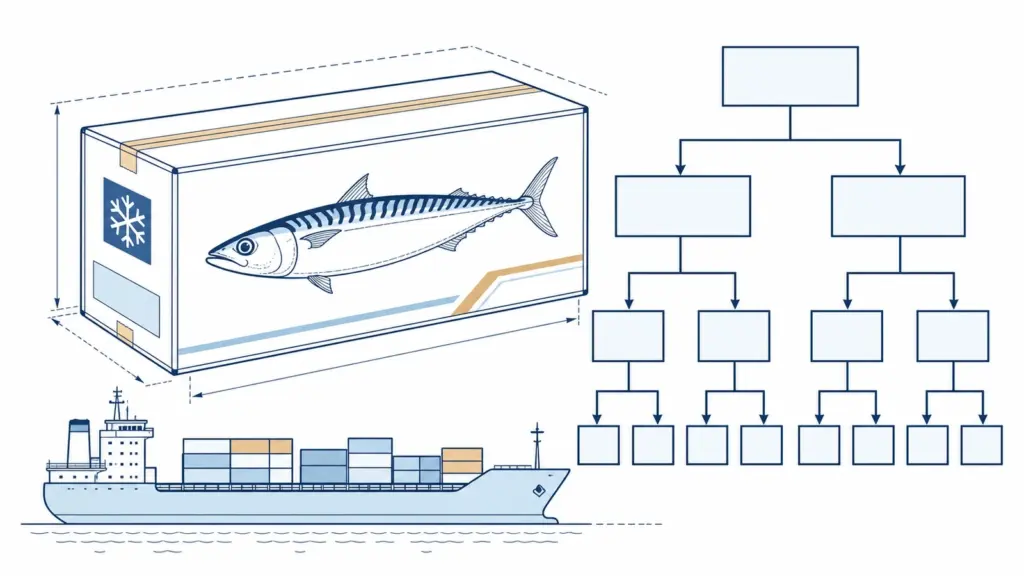
Every HS code follows a logical six-digit architecture that becomes more specific as digits are added from left to right. Understanding this hierarchy helps exporters verify that their products land in the correct subheading.
| Level | Digits | Example | Meaning |
|---|---|---|---|
| Chapter | 2 | 03 | Fish and crustaceans, molluscs and other aquatic invertebrates |
| Heading | 4 | 0303 | Fish, frozen (excluding fillets and other fish meat of heading 0304) |
| Subheading (HS) | 6 | 0303.54 | Mackerel (Scomber scombrus, Scomber australasicus, Scomber japonicus), frozen |
The first two digits place the product in Chapter 3, which covers all fish and seafood commodities in international trade. The four-digit heading 0303 narrows the scope to frozen fish — but critically, it excludes fish fillets and other fish meat, which fall under a separate heading. The six-digit subheading isolates the specific species: mackerel.
Countries may append additional digits beyond the six-digit HS base for national tariff purposes. The United States uses ten-digit HTS codes, the European Union uses ten-digit TARIC codes, and China uses its own national extensions. However, the six-digit subheading is the globally harmonized code that all jurisdictions recognize — making it the single most important number to get right on your export documentation.
Why Correct Classification Matters
Misclassification carries direct financial and operational consequences. Customs authorities in major importing markets, including the US CBP and EU member state agencies, have dedicated seafood audit teams that review frozen fish entries. A misclassified mackerel shipment can trigger a binding ruling review, which halts clearance and may result in retroactive duty assessments if the error is systemic. For a B2B exporter shipping regular container volumes, even a single classification dispute can disrupt buyer inventory cycles and damage trading relationships built over years.
Key Mackerel HS Codes for Frozen Products
The frozen mackerel product family spans multiple HS headings depending on processing state and presentation. Exporters must map each product variant to its correct code before generating commercial invoices or certificates of origin.
Primary Frozen Mackerel Subheadings (Heading 0303)
Frozen mackerel that is whole, headed and gutted (H&G), or otherwise presented — but not further processed into fillets — classifies under heading 0303. The relevant six-digit subheadings within the mackerel species group include the following.
| HS Subheading | Product Description |
|---|---|
| 0303.54 | Mackerel (Scomber scombrus, Scomber australasicus, Scomber japonicus), frozen, excluding fillets and other fish meat |
| 0303.55 | Jack and horse mackerel (Trachurus spp.), frozen, excluding fillets and other fish meat |
| 0303.89 | Other frozen fish, not elsewhere specified — applicable when species falls outside the named subheadings |
For the vast majority of commercially traded frozen mackerel shipments — including Pacific mackerel (Scomber japonicus), Atlantic mackerel (Scomber scombrus), and blue mackerel (Scomber australasicus) — subheading 0303.54 is the correct frozen mackerel HS code 0303 classification. This covers whole round, H&G, and other non-fillet presentations commonly exported from processing origins in Asia and South America.
Species identification is the critical determination. If you are shipping Trachurus species — jack mackerel or horse mackerel — the correct subheading shifts to 0303.55. Subheading 0303.89 serves as a residual category for frozen fish species that do not have their own named six-digit breakouts, though most commercial mackerel species are explicitly named.
Frozen Mackerel Fillets (Heading 0304)
When mackerel is further processed into fillets or other fish meat, the classification shifts from heading 0303 to heading 0304, which captures “fish fillets and other fish meat (whether or not minced), fresh, chilled, or frozen.” The applicable subheading is typically:
| HS Subheading | Product Description |
|---|---|
| 0304.49 | Frozen fillets of other fish (not tilapia, catfish, carp, eels, Nile perch, or snakeheads) |
Subheading 0304.49 covers frozen mackerel fillets because mackerel is not among the enumerated species with their own six-digit fillet subheadings. This classification applies regardless of whether fillets are skin-on or skinless, as long as they meet the definition of a fillet — slices of fish cut parallel to the backbone.
Country-Specific Extensions
While the six-digit code is globally harmonized, exporters should verify the full national tariff code with the importer or customs broker. A frozen mackerel HS code 0303 shipment entering the EU, for example, requires a ten-digit TARIC code that adds detail about presentation, catch method, and whether the product falls under autonomous tariff suspensions. The WTO Tariff Data portal provides a useful cross-reference for comparing applied MFN rates across importing countries.
Critical Documentation for HS Code Compliance
The HS code on your documentation is the first thing a customs officer checks against the physical cargo description. Inconsistencies between documents are among the most common triggers for customs examination in frozen seafood shipments.
Commercial Invoice Requirements
The commercial invoice must state the HS code clearly for each line item, accompanied by a precise product description that supports that classification. A description reading “frozen fish” is insufficient and invites scrutiny. Instead, specify: “Frozen whole round Pacific mackerel (Scomber japonicus), HS 0303.54, 200-300g, 10kg block, origin China.”
Key invoice elements that support HS code classification include:
- Full scientific species name (genus and species)
- Processing state (whole round, H&G, fillet, loin)
- Freezing method (land-frozen, sea-frozen, IQF, block-frozen)
- Net weight and package configuration
- Country of origin and vessel or processing facility identifiers
Certificate of Origin and FTA Documentation
The certificate of origin serves a dual role: it verifies the product’s originating country for customs purposes, and it enables qualification for preferential tariff treatment under applicable free trade agreements. The HS code on the certificate of origin must match the commercial invoice and, when an FTA preference is claimed, align with the product-specific rules of origin in the relevant agreement.
Discrepancies between the invoice HS code and the certificate of origin HS code are one of the most frequent documentary errors flagged by customs. This is entirely avoidable through a pre-shipment documentation review process that cross-checks all trade documents for HS code consistency.
Additional Supporting Documents
Depending on the importing country’s requirements, the following may also need to reference the HS code:
- Health certificates issued by the competent authority of the exporting country
- Catch certificates under IUU (Illegal, Unreported, and Unregulated) fishing regulations, particularly for EU-bound shipments
- Packing lists that tie container and seal numbers to specific product lines and their HS classifications
- Bill of lading cargo descriptions that align with the HS-based product description on the invoice
For guidance on mackerel product specifications that support accurate classification, refer to the frozen mackerel specifications or explore our range of Pacific mackerel products.
Preferential Tariff Schemes and Duty Reduction
A correctly assigned HS code does more than ensure compliance — it unlocks access to preferential tariff rates that can reduce or eliminate import duties for qualifying shipments.
How FTAs Use HS Codes
Free trade agreements define product coverage and rules of origin by HS code. When a frozen mackerel product qualifies under an FTA — for example, a shipment originating in a country that is party to a bilateral or regional trade agreement with the destination market — the importer may claim a reduced or zero duty rate. The preferential rate is tied to the specific HS subheading, so misclassification can inadvertently forfeit duty savings that buyers expect.
Key trade arrangements relevant to mackerel trade include the Comprehensive and Progressive Agreement for Trans-Pacific Partnership (CPTPP), various EU Generalized Scheme of Preferences (GSP) arrangements, the African Continental Free Trade Area (AfCFTA), and bilateral agreements between major seafood exporting and importing nations.
Product-Specific Rules of Origin
Each FTA specifies product-specific rules (PSRs) at the HS subheading level. A common PSR for frozen mackerel under heading 0303 might require that the fish be wholly obtained — caught within the waters of the exporting party — or that any non-originating materials undergo a change in tariff classification at the heading level. Exporters planning to leverage preferential rates should work with their buyers to confirm that the shipment satisfies the PSR for the specific HS code claimed on the certificate of origin.
Practical Steps for Exporters
To maximize the value of preferential tariff schemes, exporters should first confirm the six-digit HS subheading with the buyer’s customs broker before shipment. Second, verify the applicable FTA rule of origin for that subheading. Third, ensure the certificate of origin and supporting catch documentation are aligned and issued by the authorized body. Finally, maintain a record of HS code determinations per product code so that repeat shipments benefit from consistent treatment.
Common Classification Errors and How to Avoid Them
Customs authorities worldwide consistently flag the same classification mistakes in frozen seafood entries. Awareness of these patterns helps exporters avoid them.
Error 1: Confusing Whole Round with Fillets
The most frequent mackerel classification error is filing frozen mackerel fillets under heading 0303 (whole fish) instead of heading 0304 (fillets). The WCO Explanatory Notes make clear that heading 0303 covers fish presented whole, headed and gutted, or otherwise cut but not qualifying as fillets or fish meat. Fillets — slices of fish cut parallel to the backbone — belong in heading 0304. The duty rate differential between these two headings can be significant, and misclassification in either direction creates a compliance exposure.
Error 2: Incorrect Species Identification
Subheadings 0303.54 (Scomber spp. mackerel) and 0303.55 (Trachurus spp. jack and horse mackerel) are close in nomenclature but distinct in tariff treatment. Exporters handling both species must ensure the scientific name on the invoice supports the HS code selected. Generic product descriptions such as “frozen mackerel” are insufficient; customs authorities increasingly expect the Linnaean binomial.
Error 3: Overlooking Processing State Details
Freezing method, glazing percentage, and added ingredients can shift classification. For example, mackerel that has been seasoned, cooked, or combined with sauce or marinade may fall outside Chapter 3 entirely and into Chapter 16 (prepared or preserved fish). Exporters shipping value-added mackerel products alongside standard frozen whole round must apply different HS codes to each line item.
Error 4: Documentation Inconsistency
As noted in the documentation section, HS code mismatches between the commercial invoice, certificate of origin, bill of lading, and health certificate are a leading cause of customs holds. A disciplined pre-shipment review workflow — where one person verifies HS code alignment across all trade documents — prevents this entirely. For B2B shippers managing multiple containers per month, this single quality-control step delivers an outsized return in customs clearance reliability.
Best Practices for Accurate Classification
Adopt a species-first approach: identify the scientific name, then navigate the HS structure to the correct subheading. Cross-reference with the WCO HS database and your buyer’s national tariff schedule. When ambiguity exists, request a binding tariff classification ruling from the importing country’s customs authority — this provides legal certainty for current and future shipments. For exporters shipping across multiple product categories, refer to the broader seafood export HS codes guidance and consult our company’s trade specialists for product-specific mackerel trade compliance documentation.
Conclusion
HS code classification sits at the intersection of trade compliance, duty optimization, and supply chain reliability. For frozen mackerel exporters, mastering the distinction between heading 0303 and heading 0304, understanding species-level subheadings within the mackerel family, and maintaining rigorous documentation alignment across all trade documents are the three pillars of customs clearance success.
A correctly classified shipment clears faster, qualifies for preferential duty treatment where applicable, and reinforces your reputation as a reliable B2B supplier. An incorrectly classified shipment — even when the error is inadvertent — erodes buyer trust and creates costs that cascade through the supply chain. Investing in classification accuracy is investing in your commercial relationship with every buyer who receives your containers.
Whether you are shipping frozen whole round Pacific mackerel, H&G Atlantic mackerel, or value-added mackerel products, the principles in this guide apply consistently. Cross-check your HS codes, align your documentation, and leverage the free trade agreements available in your trade lanes.
Contact Hanxing Seafood today at sales@hanxingseafood.com or visit www.hanxingseafood.com to discuss mackerel export documentation and shipping requirements.
Looking for a Frozen Seafood Supplier?
Contact HANXING SEAFOOD to confirm current availability, specifications, packing, and quotation details.
Request a Quote