
China’s Frozen Mackerel Industry: Processing Capacity, Export Markets and Trade Dynamics
Introduction
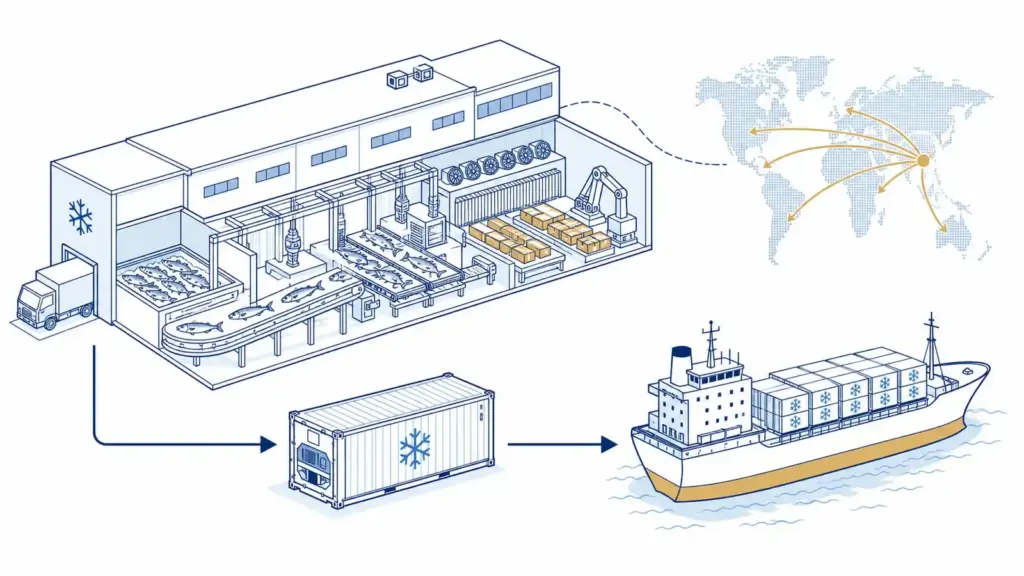
China has established itself as the world’s largest processor and exporter of frozen seafood products, and mackerel occupies a central position within this vast trade network. For international seafood buyers, understanding the structure and dynamics of the China mackerel export industry is essential to making informed sourcing decisions. The country’s combination of large-scale processing capacity, competitive labor costs, modern cold chain infrastructure, and expanding free trade agreements has created a formidable export engine that supplies frozen mackerel to markets across Africa, Southeast Asia, Europe, and the Middle East.
This article provides a comprehensive overview of China’s frozen mackerel processing ecosystem, examining the major production hubs, export volume trends, key destination markets, cold chain capabilities, certification frameworks, and the evolving impact of trade agreements. Whether you are a first-time importer or an experienced procurement manager, this guide delivers the trade intelligence needed to navigate China’s mackerel export landscape with confidence.
Table of Contents
- China’s Mackerel Processing Landscape and Key Hubs
- Export Volume Trends and Global Market Share
- Primary Destination Markets and Trade Dynamics
- Cold Chain Infrastructure and Logistics Capabilities
- Certifications, Compliance, and Trade Agreement Impacts
- Conclusion
China’s Mackerel Processing Landscape and Key Hubs
China’s frozen mackerel processing industry is geographically concentrated in several coastal provinces, each with distinct specializations and advantages. Understanding where your product originates is critical for evaluating processing quality, logistics costs, and supply reliability.
The primary processing hub is Fujian Province, particularly the cities of Fuzhou, Zhangzhou, and Xiamen. Fujian accounts for an estimated 35 to 40 percent of China’s total frozen mackerel processing output. The province benefits from a long-established seafood processing tradition, proximity to major mackerel fishing grounds in the East China Sea and Taiwan Strait, and well-developed port infrastructure. Processors in this region typically handle both domestically caught mackerel and imported raw material from vessels operating in the Northwest Pacific. Many factories in Fujian have invested heavily in automated filleting, grading, and IQF (Individually Quick Frozen) lines over the past decade, significantly improving throughput and consistency.
Shandong Province, centered on Qingdao, Weihai, and Yantai, represents the second-largest processing cluster. Shandong processors are particularly strong in producing frozen whole-round mackerel and butterfly-cut products destined for African and Middle Eastern markets. The province’s proximity to major fishing ports in the Yellow Sea and its historical role as a gateway for China-Japan-Korea seafood trade give it unique advantages in raw material procurement and cold storage capacity.
Zhejiang Province, with Zhoushan as its anchor, is another significant processing region. Zhoushan is home to one of China’s largest fishing fleets and serves as a major landing point for pelagic species including mackerel. Processors here often integrate vertically with fishing operations, offering buyers shorter supply chains and better traceability from vessel to cold store.
Liaoning Province in the northeast, particularly Dalian, rounds out the major hubs. Liaoning’s colder water ports provide natural advantages for maintaining cold chain integrity, and the province has carved out a niche in higher-value mackerel products processed for discerning markets including Japan and South Korea.
The total annual processing capacity for frozen mackerel across these four provinces is estimated at over 1.2 million metric tons, though actual utilization rates fluctuate based on raw material availability and export demand cycles. According to data tracked by the Food and Agriculture Organization, China’s reported mackerel landings and processing volumes have remained consistently high over the past decade, reflecting the sector’s structural importance to the national seafood economy.
For B2B buyers, the concentration of processing in well-defined hubs simplifies sourcing. A visit to Fujian or Shandong allows a procurement team to audit multiple factories within a single trip, comparing capabilities, certifications, and pricing across competitors. Reputable exporters such as Hanxing Seafood maintain facilities and partner relationships in these key regions, giving international buyers access to aggregated production capacity with streamlined quality oversight.
Export Volume Trends and Global Market Share
China’s frozen mackerel export volumes have demonstrated consistent growth over the past fifteen years, though the trajectory has not been linear. The country’s share of global frozen mackerel trade has expanded from roughly 18 percent in 2010 to an estimated 28 to 32 percent in 2024, making China the single largest exporter of frozen mackerel products by volume.
Several factors have driven this expansion. First, China’s accession to the WTO and subsequent tariff reductions on seafood exports opened doors to markets that were previously difficult to access. Second, the country’s massive investment in processing infrastructure during the 2010s created a scale advantage that smaller competitors could not match. Third, China’s fishing fleet modernization program, which included subsidies for distant-water vessels, expanded the raw material supply available to domestic processors. Between 2015 and 2022, annual frozen mackerel export volumes from China grew at a compound annual rate of approximately 6 to 8 percent, with particularly strong growth in shipments to West African and Southeast Asian markets.
However, recent trends warrant attention. The 2023-2024 period saw some moderation in export growth as global inflation pressured demand in price-sensitive markets and as competing origins like Norway, Japan, and Vietnam increased their own mackerel processing output. Chinese exporters have responded by shifting product mix toward value-added formats such as seasoned fillets, portion-controlled cuts, and retail-ready packaging, sectors where margins are higher and competition is less intense.
The species composition of Chinese mackerel exports is dominated by Scomber japonicus (chub or Pacific mackerel), which represents an estimated 60 to 70 percent of export volume. Scomber australasicus (spotted or blue mackerel) accounts for much of the remainder, with smaller volumes of Scomber scombrus (Atlantic mackerel) entering the processing stream when global catch conditions permit. Buyers should be aware that product labeled simply as “frozen mackerel” from Chinese suppliers may contain any of these species unless explicitly specified in the contract. The ITIS taxonomic database provides authoritative classification references that can be cited in purchase specifications to eliminate ambiguity.
For importers, the key takeaway is that China’s dominant export position provides both advantages and considerations. The sheer volume of product flowing through Chinese processing facilities means that large, consistent orders can be fulfilled with relative ease. At the same time, the scale of the industry means that quality differentiation among suppliers is significant, and buyers must invest in due diligence to identify processors that meet their specific requirements.
Primary Destination Markets and Trade Dynamics
China’s frozen mackerel exports flow into a diverse portfolio of destination markets, each with distinct demand profiles, regulatory requirements, and competitive dynamics.
Africa is the largest regional market for Chinese frozen mackerel, absorbing an estimated 35 to 40 percent of total export volume. Within Africa, Nigeria, Ghana, Cote d’Ivoire, and Egypt are the leading importers. African demand is heavily concentrated in the frozen whole-round segment, typically smaller-sized fish (100-200g and 200-300g per piece) that offer an affordable protein source for mass-market consumption. The trade is highly price-sensitive, and Chinese exporters compete primarily on delivered cost per kilogram. Buyers serving African markets should pay close attention to logistics costs, as reefer container freight rates from Chinese ports to West Africa represent a substantial share of total landed cost. Political and currency stability in destination countries also introduces risk factors that experienced traders factor into their pricing and payment terms.
Southeast Asia is the second-largest regional destination, led by the Philippines, Thailand, Indonesia, and Vietnam. Southeast Asian demand spans a wider product range, from whole-round mackerel for traditional wet markets to processed fillets and portions for canneries and food service. The region’s proximity to Chinese ports means shorter transit times and lower freight costs, making it an attractive market for exporters and importers alike. Thailand, in particular, has emerged as both a destination market and a re-processing hub, where Chinese-origin frozen mackerel is further processed into loins, canned products, and value-added formats before re-export to Japan, Europe, and North America.
The Middle East and North Africa (MENA) region, including markets such as Saudi Arabia, UAE, and Iran, represents a growing destination for Chinese mackerel exports. Demand here is driven by a combination of traditional consumption patterns, expanding food service sectors, and government-led food security initiatives that encourage diversified protein imports. Halal certification requirements are universal in most MENA markets, and Chinese processors serving this region have adapted accordingly, with many major plants now maintaining halal certification alongside their standard quality management systems.
Europe accounts for a smaller but strategically important share of Chinese mackerel exports. EU market access requires compliance with strict food safety regulations, including HACCP implementation, EU-approved establishment listing, and catch certificate documentation under the IUU (Illegal, Unreported and Unregulated) fishing regulation. Chinese processors that have invested in EU-compliant facilities tend to command premium pricing and enjoy more stable customer relationships. The EU market also demands larger-sized mackerel (typically 300-500g and 500g+ per piece) compared to African markets, reflecting different consumption patterns and processing applications.
Russia and CIS countries form another significant destination bloc, with demand concentrated in whole-round frozen mackerel for traditional salted, smoked, and canned preparations. Trade flows in this corridor are influenced by geopolitical dynamics and bilateral trade agreements between China and Russia, introducing a layer of complexity that buyers should monitor.
A handful of Chinese seafood exporters have established multi-market capabilities that allow them to serve buyers across different regions seamlessly. Hanxing Seafood’s export portfolio spans these key markets, giving international buyers a single point of contact for products tailored to diverse destination requirements, from African price-point demands to European regulatory standards.
Cold Chain Infrastructure and Logistics Capabilities
The cold chain forms the backbone of China’s frozen mackerel export industry, and the country has invested billions of dollars in building one of the world’s most extensive refrigerated logistics networks.
China’s cold storage capacity has expanded dramatically, with total refrigerated warehouse space exceeding 150 million cubic meters as of 2024. The major seafood processing hubs in Fujian, Shandong, Zhejiang, and Liaoning each host large-scale cold storage facilities located within or adjacent to major fishing ports and processing zones. These facilities maintain temperatures ranging from minus 18 degrees Celsius to minus 25 degrees Celsius, with blast freezing tunnels capable of bringing freshly processed mackerel to core temperatures below minus 18 degrees Celsius within hours of production.
Port infrastructure is equally critical. Chinese ports including Xiamen, Qingdao, Ningbo-Zhoushan, and Dalian rank among the world’s busiest container ports and maintain extensive reefer plug capacity. The Port of Qingdao, for example, operates over 12,000 reefer plugs, ensuring that containers of frozen mackerel can be stored on-terminal without cold chain interruption while awaiting vessel loading. Major shipping lines serving Chinese ports offer direct reefer services to key destination regions, with typical transit times of 25 to 35 days to West Africa, 7 to 14 days to Southeast Asia, and 28 to 35 days to European ports.
The inland cold chain connecting processing facilities to export ports has also matured significantly. Dedicated reefer truck fleets, temperature-monitored rail services, and GPS-tracked container movements have become standard practice among tier-one exporters. Many processors now offer buyers real-time temperature logging data for individual shipments, providing the documentation needed to satisfy import inspection requirements and internal quality assurance protocols.
The NOAA Fisheries profile on Pacific mackerel notes that maintaining cold chain integrity from harvest through processing and distribution is fundamental to preserving the quality characteristics that make mackerel a valuable traded commodity. Chinese cold chain investments have brought the country’s infrastructure broadly in line with international best practices, though variations in quality among individual logistics providers mean that buyers should work with exporters who exercise rigorous oversight of their cold chain partners.
Certifications, Compliance, and Trade Agreement Impacts
Navigating the regulatory landscape is a critical competency for any buyer sourcing frozen mackerel from China. The certification framework that governs Chinese seafood exports has become increasingly sophisticated, driven by both regulatory requirements in destination markets and competitive pressure among exporters to differentiate on quality assurance.
The baseline certification held by virtually all legitimate export-oriented processors is HACCP (Hazard Analysis and Critical Control Points), which is a mandatory requirement for seafood processing facilities exporting from China. Beyond HACCP, the most commonly encountered certifications include ISO 22000 (Food Safety Management Systems), BRC (British Retail Consortium Global Standard for Food Safety), and IFS (International Featured Standards). Processors targeting EU markets must additionally hold EU approval numbers issued by the China Certification and Accreditation Administration (CNCA), while those serving the US market require FDA registration and must comply with the Seafood HACCP regulation (21 CFR 123).
For specific market segments, additional certifications come into play. Halal certification, issued by recognized Islamic bodies, is essential for shipments to the Middle East, North Africa, and Muslim-majority markets in Southeast Asia. MSC (Marine Stewardship Council) certification, while still relatively rare in the Chinese mackerel sector compared to European and North American fisheries, is gaining traction as sustainability considerations become more prominent in procurement decisions. BAP (Best Aquaculture Practices) certification is less relevant for wild-caught mackerel but may appear in the broader portfolios of diversified Chinese seafood exporters.
The China-ASEAN Free Trade Area (CAFTA) agreement has been a particularly significant driver of mackerel trade flows, eliminating or substantially reducing tariffs on frozen mackerel moving from China to ASEAN member states. This has reinforced Southeast Asia’s position as a key destination market and encouraged trade integration. Similarly, China’s bilateral trade agreements with African nations and its participation in the Belt and Road Initiative have facilitated trade finance, logistics infrastructure development, and customs cooperation that benefit the frozen seafood trade. The RCEP (Regional Comprehensive Economic Partnership) agreement, which entered into force in 2022, is expected to further liberalize seafood trade among its 15 member economies, potentially opening new opportunities for Chinese mackerel exports to markets like Japan and South Korea where tariff barriers have historically been higher.
For buyers, the certification landscape means that due diligence should include verification of the specific certifications required by their destination market and a clear understanding of which certifications their supplier genuinely holds versus those claimed but not verifiable. Working with established exporters that maintain transparent certification documentation, such as through Hanxing Seafood’s quality assurance framework, reduces the compliance risk inherent in cross-border seafood procurement.
Conclusion
The China mackerel export industry represents a mature, large-scale, and increasingly sophisticated segment of the global seafood trade. With processing capacity concentrated in the four key coastal provinces of Fujian, Shandong, Zhejiang, and Liaoning, international buyers have access to a deep and diverse supplier base capable of producing frozen mackerel products across the full spectrum of species, sizes, cuts, and value-added formats. China’s dominant position in global frozen mackerel trade, supported by extensive cold chain infrastructure and port capabilities, offers buyers the advantages of scale, consistency, and logistical efficiency.
At the same time, the regulatory demands of different destination markets and the quality variation among suppliers mean that successful sourcing depends on rigorous due diligence. Understanding the specific certifications required for your market, verifying supplier credentials, and establishing clear product specifications that reference authoritative taxonomic sources like the FishBase species database are essential steps in building a reliable supply chain.
As trade agreements continue to reshape tariff structures and market access conditions, the competitive landscape for Chinese mackerel exports will keep evolving. Buyers who stay informed on these dynamics and build relationships with credible, transparent suppliers will be best positioned to secure consistent quality and value from the world’s largest frozen mackerel export market.
For professional guidance on sourcing frozen mackerel from China’s leading processing regions, contact our export team at sales@hanxingseafood.com or visit www.hanxingseafood.com to explore our product range, certifications, and supply chain capabilities.
Looking for a Frozen Seafood Supplier?
Contact HANXING SEAFOOD to confirm current availability, specifications, packing, and quotation details.
Request a Quote