
Blue Mackerel, True Mackerel and Spotted Mackerel: Trade Name Confusion and Commercial Reality
Introduction
The global frozen mackerel trade moves hundreds of thousands of metric tons annually, yet confusion around common trade names continues to create risks for importers and distributors. Three names in particular — blue mackerel, true mackerel, and spotted mackerel — appear on commercial invoices, quality certificates, and customs declarations, often without the scientific precision that reliable procurement demands. A buyer ordering “mackerel” may receive Scomber australasicus from Australian waters, Scomber scombrus from the North Atlantic, or a Scomberomorus species from Southeast Asia, each carrying a different market value and regulatory profile.
This article disentangles the trade name problem by examining each species group: its scientific classification, identification markers, distribution, commercial value, and the risks posed by ambiguous labeling. For B2B seafood professionals managing frozen mackerel supply chains, understanding these distinctions is a compliance necessity and a cost management tool.
Table of Contents
- Blue Mackerel (Scomber australasicus): The Indo-Pacific Workhorse
- True Atlantic Mackerel (Scomber scombrus): The North Atlantic Benchmark
- Spotted Mackerel (Scomberomorus spp.): A Genus of Distinct Commercial Value
- Trade Name Risks and Documentation Best Practices
- Conclusion
Blue Mackerel (Scomber australasicus): The Indo-Pacific Workhorse
Identification and Distribution
Blue mackerel (Scomber australasicus) is a pelagic-neritic species distributed across the Indo-West Pacific, from southern Japan through Southeast Asia to Australia and New Zealand, with isolated stocks off Hawaii and Mexico’s Socorro Island. The species inhabits continental shelf and inshore waters from the surface to approximately 200 meters, forming large schools accessible to purse seine and midwater trawl operations.
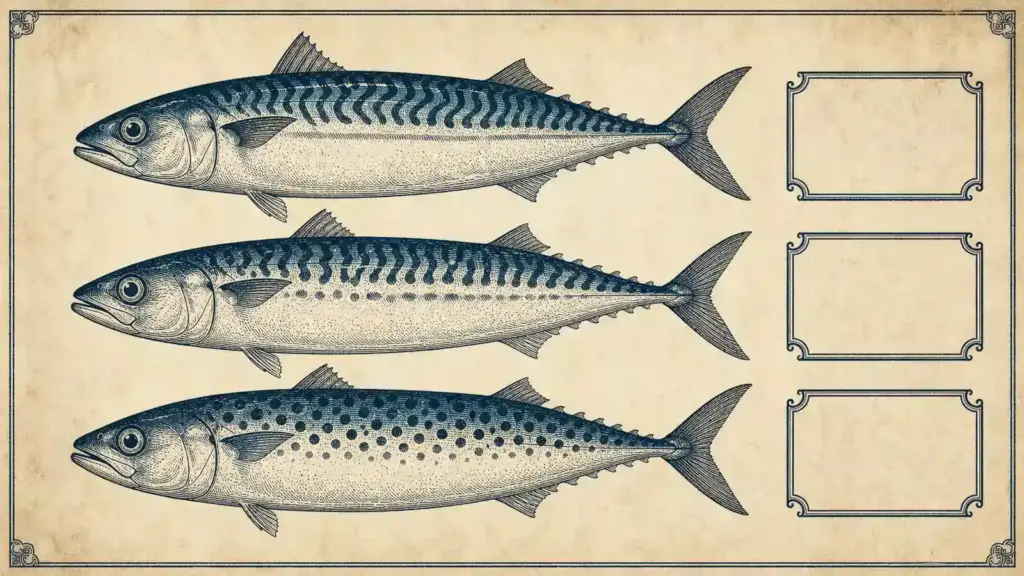
Morphologically, blue mackerel displays a streamlined fusiform shape with a blue-green back marked by zigzagging oblique lines and a pearly white belly. Key identification features include a swim bladder that is present (absent in Scomber japonicus), 10 to 13 dorsal spines, and a maximum fork length of approximately 44 centimeters, with New Zealand specimens reaching 55 centimeters.
Commercial Profile and Market Position
Australia’s blue mackerel fishery is managed as two biological stocks — eastern and western — both classified as sustainable under the Commonwealth harvest strategy framework. The eastern stock carries a Total Allowable Catch of 11,440 tonnes, with an exploitation rate of approximately 15 percent, well within the 50 percent target reference point.
For B2B buyers, blue mackerel occupies a distinct nutritional niche. At approximately 2.89 percent crude fat content, it is notably leaner than Atlantic mackerel, yielding firmer flesh that performs well in canning, drying-salting, and smoked applications. The lower fat also contributes to superior frozen shelf stability for long-distance shipments. Blue mackerel is often captured alongside Pacific mackerel in mixed pelagic fisheries, and buyers should verify catch composition documentation. Hanxing Seafood maintains detailed frozen mackerel specifications to support precise procurement.
True Atlantic Mackerel (Scomber scombrus): The North Atlantic Benchmark
What “True Mackerel” Means in Commerce
The term “true mackerel” in seafood trade refers to Scomber scombrus, the Atlantic mackerel, which is genetically the most basal Scomber species. Genetic analysis shows a distance of approximately 0.095 to 0.096 between S. scombrus and S. australasicus, versus 0.017 between S. australasicus and S. japonicus, confirming Atlantic mackerel as the most divergent member.
Atlantic mackerel ranges across the North Atlantic, from Labrador to Cape Hatteras on the west and from Iceland and Norway to the Mediterranean and Black Sea on the east. Larger than blue mackerel at up to 60 centimeters fork length, it exhibits higher fat content prized for fresh and smoked products. The anterior dorsal fin bears 11 to 13 spines, the body is marked with dark wavy bands on the upper sides, and unlike blue mackerel, the swim bladder is absent.
Market Differentiation
For importers, distinguishing Atlantic mackerel from Indo-Pacific relatives carries direct commercial consequences. Atlantic mackerel commands a price premium in European and North American markets where its eating quality is well established, with higher amino acid content — approximately 190.63 mg/g versus 169.49 mg/g for blue mackerel.
NOAA Fisheries manages the U.S. Atlantic mackerel stock under a rebuilding plan. A common pitfall occurs when “mackerel” on a bill of lading refers to S. australasicus or S. japonicus rather than S. scombrus. Learn more about Hanxing Seafood’s sourcing standards for species verification across our supply chain.
Spotted Mackerel (Scomberomorus spp.): A Genus of Distinct Commercial Value
Not One Species, But Several
The term “spotted mackerel” introduces an entirely different layer of complexity: it refers not to the genus Scomber at all, but to species within the genus Scomberomorus. The FAO Scombridae catalogue identifies multiple commercially significant species carrying spotted markings:
-
Australian spotted mackerel (Scomberomorus munroi) ranges across northern Australia into southern Papua New Guinea. This species displays rows of round spots larger than the pupil, reaches approximately 104 centimeters fork length, and is the second most important finfish fishery in Queensland, with annual production around 1,000 metric tonnes.
-
Japanese Spanish mackerel (Scomberomorus niphonius), also called spotted mackerel or sawara, is distributed from the Yellow Sea and Sea of Japan to Vladivostok. Distinguished by seven or more longitudinal rows of small spots and the only Scomberomorus species with a straight intestine, it reaches up to 113 centimeters total length. IUCN status is Near Threatened as of 2022.
-
Atlantic Spanish mackerel (Scomberomorus maculatus) inhabits the western Atlantic and Gulf of Mexico, bearing brassy or brownish-yellow oval spots on its flanks. The Gulf of Mexico fishery lands approximately 630 metric tonnes annually with a dockside value exceeding one million U.S. dollars.
-
Narrow-barred Spanish mackerel (Scomberomorus commerson) juveniles appear spotted, but adults develop numerous thin vertical bars. Reaching 240 centimeters and 70 kilograms, it dwarfs all other species discussed here.
Commercial Considerations for Spotted Mackerel Imports
Spotted mackerel species generally command higher unit prices than Scomber mackerels, reflecting larger average size, firmer texture, and strong regional demand. However, importers face species-specific considerations: S. niphonius is Near Threatened, and certain Scomberomorus from Queensland have been associated with ciguatera-like toxin risk. Buyers may also review Hanxing Seafood’s frozen horse mackerel product range for comparable pelagic species.
Trade Name Risks and Documentation Best Practices
How Ambiguous Labeling Creates Liability
The mackerel trade name problem carries real consequences in frozen seafood trade:
Customs and Regulatory Non-Compliance. Importing countries increasingly require HS codes matched to scientific species identification. A shipment declared as “frozen mackerel” without a verifiable scientific name may be flagged, delayed, or rejected. The U.S. FDA Seafood List, EU Common Market Organization, and China’s labeling standards all mandate species-level accuracy.
Commercial Disputes. When a buyer contracts for Atlantic mackerel and receives blue mackerel, financial exposure extends beyond cost differential. Rejection, cold storage fees, and demurrage multiply the original invoice gap. A guide to seafood label accuracy is available in Hanxing Seafood’s blog.
Processing Performance. Different species behave differently under processing. Blue mackerel at 2.89 percent fat produces a firmer canned product than Atlantic mackerel. A processor calibrated for one species encounters quality deviations when a substitute arrives.
Practical Documentation Protocol
B2B buyers should insist on the following minimum documentation for every frozen mackerel shipment:
- Scientific species name on every commercial invoice, packing list, and bill of lading.
- Catch area (FAO fishing zone) to verify geographic plausibility against known species distribution.
- Catch method to support sustainability certifications.
- Third-party species verification where supply chains involve multiple intermediaries.
Cross-referencing declared species against the FAO Fisheries Species Fact Sheets and FishBase should be routine pre-contract practice. The ITIS taxonomic record for S. australasicus provides authoritative nomenclature data, while NOAA’s Atlantic mackerel profile offers equivalent detail for S. scombrus. For morphological reference, the FAO Scombridae Species Catalogue remains the authoritative taxonomic resource.
Conclusion
Blue mackerel, true Atlantic mackerel, and spotted mackerel are not interchangeable products wearing different regional names — they are biologically distinct species occupying separate oceans, delivering different nutritional profiles, and carrying different market valuations. Confusing Scomber australasicus with Scomber scombrus or conflating Scomber with Scomberomorus introduces real financial, regulatory, and quality risk.
For B2B buyers, the solution begins with insisting on scientific species names in all trade documentation and verifying declared species against known distribution and morphological markers. It extends to sourcing through partners maintaining species-level traceability from vessel to container. In an era of tightening import regulations, species identification accuracy has moved from best practice to baseline requirement.
The mackerel family’s diversity is a commercial asset when properly managed — offering buyers a range of price points, fat contents, and processing characteristics. It becomes a liability only when trade name ambiguity substitutes for scientific precision.
Contact Hanxing Seafood today at sales@hanxingseafood.com or visit www.hanxingseafood.com to discuss mackerel species sourcing and product requirements.
Looking for a Frozen Seafood Supplier?
Contact HANXING SEAFOOD to confirm current availability, specifications, packing, and quotation details.
Request a Quote