
Atlantic Mackerel (Scomber scombrus): The Definitive Species and Buyer Specification Guide
Introduction
Atlantic mackerel (Scomber scombrus) ranks among the most commercially significant pelagic species in North Atlantic fisheries, traded globally in frozen, fresh, smoked, and canned forms. For B2B seafood buyers, understanding the species’ biological characteristics, fishing seasons, product specifications, and regulatory landscape is essential to informed procurement. The species commands strong demand for its high oil content, firm flesh, and versatility — from whole round frozen to value-added fillets and smoked preparations.
This guide delivers a comprehensive technical reference spanning biology, distribution, commercial size grades, product forms, quota management, and sustainability certifications. Whether sourcing frozen mackerel for European markets, negotiating supply contracts, or evaluating supplier specifications, this reference equips importing professionals with the knowledge required to navigate the Atlantic mackerel supply chain effectively.
Table of Contents
- Biology and Species Profile of Scomber scombrus
- North Atlantic Distribution and Fishing Seasons
- Commercial Size Grades and Product Forms
- Quota Systems, MSC Certification, and Sustainability
- Buyer Specifications and Quality Parameters
Biology and Species Profile of Scomber scombrus
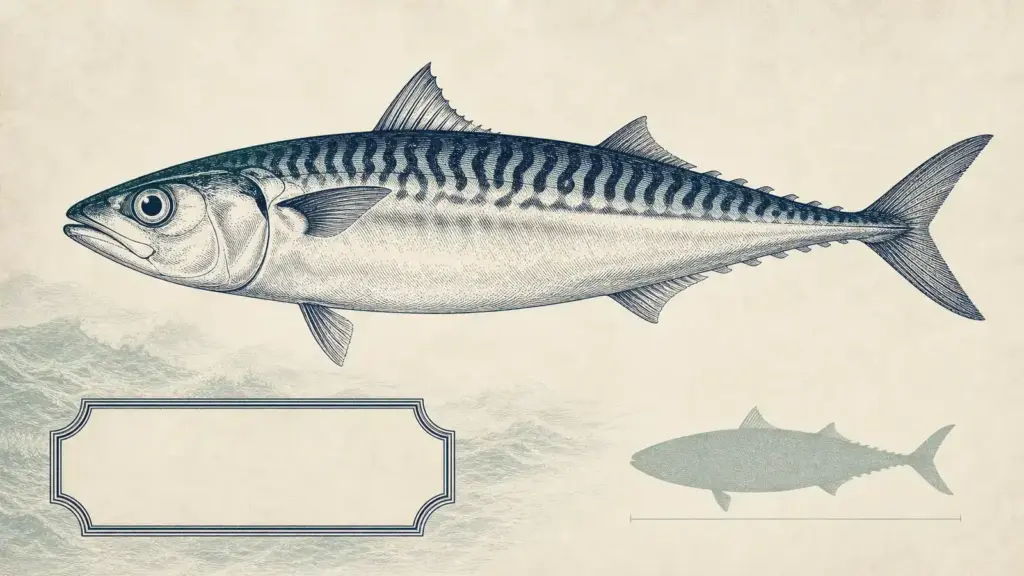
Scomber scombrus belongs to the family Scombridae, alongside tunas and bonitos. The species exhibits a streamlined, fusiform body adapted for sustained swimming in the epipelagic zone. Distinguishing anatomical features include 8 to 14 dorsal spines with 11 to 13 soft dorsal rays, 31 vertebrae, and the notable absence of a swim bladder — a trait separating it from several other Scomber species. The dorsal surface carries oblique to near-vertical dark markings with minimal undulation, while the belly remains unmarked and silvery.
Maximum fork length reaches approximately 60 cm with a maximum weight of 3.4 kg and a recorded maximum age of 17 years. Commercial catches, however, concentrate in the 200 g to 600 g range, corresponding to fish aged approximately 2 to 5 years. Sexual maturity is attained at 2 to 3 years: females in western Atlantic waters mature at around 34 cm fork length, while eastern Atlantic populations mature slightly earlier at approximately 30 cm.
Atlantic mackerel are batch spawners releasing 200,000 to 450,000 eggs per female per season. Western stock spawning progresses northward from the Mid-Atlantic Bight to Newfoundland from spring through summer. Eastern Atlantic spawning runs March through July by latitude — Mediterranean stock spawns March to April, North Sea and Kattegat/Skagerrak populations May through July. Spawning occurs 10 to 30 miles offshore in fully marine waters.
The species feeds diurnally on copepods, euphausiids, small crustaceans, fish larvae, and juvenile fish, forming large size-structured schools near the surface. Temperature governs distribution: Atlantic mackerel prefer 11 to 14 degrees Celsius, overwintering in deeper offshore waters and migrating shoreward as surface waters warm. For detailed profiles, consult NOAA Fisheries and the FAO species portal.
North Atlantic Distribution and Fishing Seasons
Atlantic mackerel exhibits an anti-tropical distribution confined to the North Atlantic, ranging from approximately 75 degrees north to 30 degrees north latitude. Two largely distinct stocks exist with minimal interchange: the Northwest Atlantic stock from Labrador to Cape Lookout, North Carolina, and the Northeast Atlantic stock encompassing waters from Iceland and Norway south to the Mediterranean, Black Sea, and Baltic Sea.
Seasonal migrations define the fishing calendar. In the Northeast Atlantic, the major season runs September through March when mackerel congregate on overwintering grounds west of Ireland and Scotland, before migrating into the Norwegian Sea and North Sea for summer feeding. Norwegian Sea peak catches occur August through October; the North Sea component is active May through November. Icelandic waters yield peak catches from July through September. In the Northwest Atlantic, the principal season extends January through May in the Mid-Atlantic Bight, shifting northward to New England and Canadian waters from June through October.
Purse seiners and pelagic trawlers account for the majority of landings. Major Northeast Atlantic fishing nations include Norway, Iceland, the UK, Ireland, Denmark, and the Faroe Islands, while the US and Canada dominate Northwest Atlantic catches. Visit our products page for current frozen mackerel origin availabilities.
Commercial Size Grades and Product Forms
B2B buyers encounter Atlantic mackerel in defined commercial size grades and product forms. The most commonly traded weight brackets are:
- 200-300 g: Suitable for whole-round retail packs, smoking, and canning where smaller uniform fish are preferred.
- 300-400 g: The most widely traded grade for European wholesale and processing markets, offering favorable meat-to-bone ratio.
- 400-500 g: Preferred for premium fillet production, food service, and high-end smoked products with larger fillet yield.
- 500-600 g: Top commercial grade for thick-cut fillets and steaks, commanding a premium price with maximum processing yield.
Three principal product forms serve different processing requirements:
Whole Round (WR): Fish frozen intact — head on, viscera in, tail on. This economical form is preferred by secondary processors operating their own heading, gutting, and filleting lines. WR mackerel is packed in 20 or 30 kg blocks or individually quick-frozen (IQF).
Headed and Gutted (H&G): Head and viscera removed; tail retained or removed per specification. H&G reduces freight weight and simplifies downstream processing for filleting operations, typically packed in 10 or 20 kg cartons.
Headed, Gutted, and Tailed (HGT): Head, viscera, and tail removed. This form maximizes container utilization and minimizes buyer-side waste, suited to automated filleting lines. HGT mackerel is frequently IQF-packed in 10 kg cartons.
Frozen storage at minus 18 degrees Celsius or below preserves quality for up to 24 months. For specification sheets and inventory, visit our products overview.
Quota Systems, MSC Certification, and Sustainability
The management framework for Northeast Atlantic mackerel is complex, with multiple coastal states sharing a migratory stock. The International Council for the Exploration of the Sea (ICES) provides scientific TAC advice, while Norway, the EU, the UK, Iceland, and the Faroe Islands jointly negotiate quota allocations.
A critical development for B2B buyers: all Marine Stewardship Council (MSC) certificates for Northeast Atlantic mackerel were suspended in March 2019 due to the breakdown of quota-sharing arrangements and persistent catches exceeding scientific advice. These suspensions remain in effect, meaning no MSC-certified Northeast Atlantic mackerel is available globally. Spawning stock biomass has declined from approximately 7.26 million tonnes (2015) to an estimated 2.8 million tonnes. ICES has recommended a substantial catch reduction to facilitate recovery.
Alternative certifications include Iceland Responsible Fisheries (IRF) certification for Icelandic-caught mackerel and Friend of the Sea (FOS) certification from select producers. Buyers requiring third-party sustainability assurance must evaluate options on a case-by-case basis. The Northwest Atlantic stock, managed by the US and Canada, operates under a rebuilding plan with a 2025 commercial quota of 868 metric tonnes. For broader sourcing context, visit our quality assurance page.
Buyer Specifications and Quality Parameters
Clear, verifiable quality specifications form the foundation of successful mackerel procurement. B2B buyers should specify:
Physical Quality: Freshly caught mackerel for freezing should show bright clear eyes, bright red gills, firm elastic flesh, and a fresh sea-like odor. Post-freezing, the product must exhibit no freezer burn, dehydration, or ice crystal damage. Glaze percentage (typically 5-10% for IQF; 0-5% for block-frozen) should be contractually stated.
Chemical Parameters: Total volatile basic nitrogen (TVB-N) should not exceed 25 mg per 100 g. Histamine is generally not a concern for properly handled Scomber scombrus, but specify a maximum 50 ppm threshold as precaution. Fat content varies seasonally — 20 to 30 percent in late summer and autumn, declining to 10 to 15 percent after winter.
Microbiological Standards: Total plate count below 100,000 CFU per gram; E. coli absent in 25 g; Salmonella absent in 25 g, aligned with EU import requirements and Codex Alimentarius.
Documentation Package: Every shipment requires a commercial invoice, packing list, bill of lading, health certificate from the exporting country’s competent authority, EU IUU-compliant catch certificate (Regulation EC No 1005/2008), and a certificate of origin for preferential tariff claims where applicable. Our export documentation guide provides detailed compliance checklists.
Conclusion
Atlantic mackerel remains a cornerstone of the global frozen seafood trade, prized for rich flavor, versatile processing options, and competitive pricing relative to alternative pelagic species. Yet B2B buyers face an increasingly complex landscape of quota constraints, certification challenges, and evolving regulatory requirements.
By specifying precise size grades, selecting the appropriate product form for processing needs, verifying documentation packages before shipment, and monitoring stock status and certification developments, importers secure high-quality Scomber scombrus while managing supply risk. Partnering with a supplier that understands these dynamics end-to-end is the single most important factor in successful Atlantic mackerel procurement.
Contact Hanxing Seafood today at sales@hanxingseafood.com or visit www.hanxingseafood.com
Looking for a Frozen Seafood Supplier?
Contact HANXING SEAFOOD to confirm current availability, specifications, packing, and quotation details.
Request a Quote