
Why Is High-Fat Mackerel More Prone to Oxidation?
Introduction
High-Fat Mackerel Oxidation can determine whether a mackerel shipment is safe, saleable, profitable, and defensible in a claim. For buyers selecting fatty mackerel for smoking, grilling, canning, and premium foodservice, reliable evaluation requires more than a quick visual check: the product must be tied to its specification, traceable lot, processing controls, temperature history, and downstream use. The central topics are lipid chemistry, product and process factors, sensory consequences, and specification controls.
A useful first step is to review the Pacific mackerel specifications and processing and fix the commercial definition of the order. Product form, size grading, glaze, packaging, shelf-life expectation, route, and customer channel shape the risk. Once that scope is fixed, inspection and testing can be focused on evidence that changes the release decision.
High-Fat Mackerel Oxidation: Clarify Scope, Risk, and Intended Use
High-Fat Mackerel Oxidation is used here to describe the degradation of highly unsaturated lipids through reactions that generate off-odors, off-flavors, discoloration, and loss of quality. Importers should identify the decision category first: safety and legality, contractual conformity, technical performance, or presentation. Mixing these categories leads to inconsistent sampling and disputes over severity.
The issue may be connected with a larger amount of oxidation-prone lipid in the edible tissue; oxygen exposure, tissue damage, and inadequate protective barriers; storage time and temperature instability; and light, pro-oxidant metals, or repeated handling. A process-stage review is more useful than a list of symptoms because it reveals where prevention should operate. Consult the review of lipid oxidation in seafood under low-temperature storage for authoritative principles. Confirm the offered form and parameters through the frozen mackerel specifications, but document the final acceptance criteria in the purchase order.
What the Shipment Can—and Cannot—Prove
The shipment itself can show warning signals, but those signals have limits. Review painty, cardboard-like, metallic, or stale odor and flavor; yellowing or browning around fatty tissues and exposed surfaces; greater defects in damaged, poorly glazed, or older product; and variation by season, biological condition, product form, and fat distribution. Record prevalence, intensity, and location, and compare findings with unaffected cartons. This distinguishes a lot trend from handling damage created during sampling or receiving.
Evidence quality depends on method. Samples must be representative and traceable; sensory terms should be specific; photographs need context; and temperatures need calibrated instruments and defined measurement points. Uncontrolled thawing can create misleading texture and drip. Use the FAO guidance on quality changes during frozen storage as supporting guidance and state the final acceptance method in the contract.
Fat Content Changes Both Value and Risk
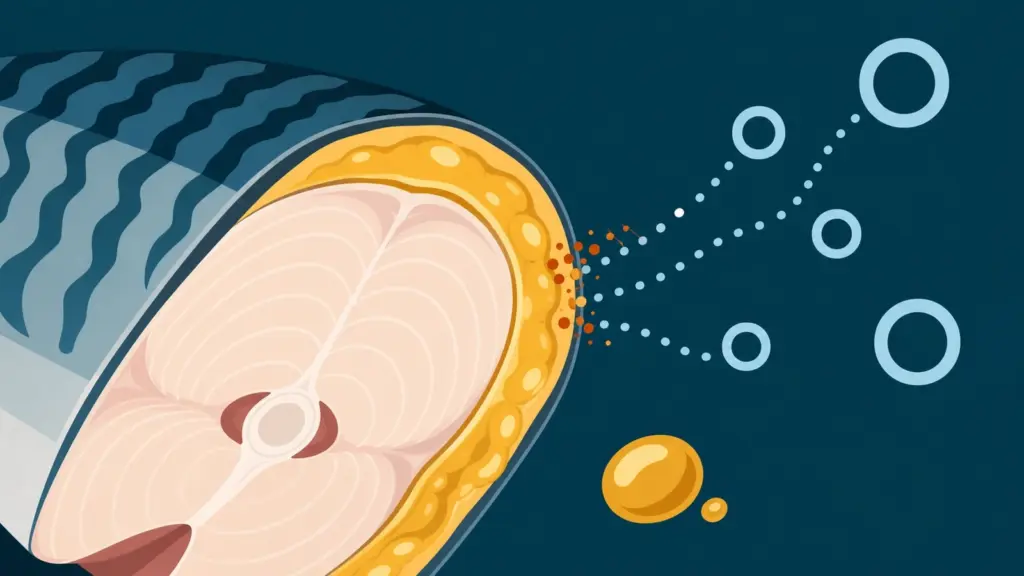
Higher-fat mackerel can offer desirable flavor, mouthfeel, and processing yield, but the same lipid fraction contains oxidation-prone fatty acids. Fat is therefore both a commercial attribute and a stability variable. Season, size, maturity, feeding, and fishing area can influence fat level, while product form affects how much surface is exposed to oxygen.
A buyer asking for high-fat fish should align the quality system with that request. Consider faster processing, careful handling, suitable glaze and packaging, stable cold storage, realistic shelf life, and sensory verification. When fat percentage is a contractual claim, define the sampling and analytical method because individual fish and different body sections can vary.
Avoid Single-Cause Assumptions
Single-cause explanations are risky because similar symptoms can arise through different routes. Build a timeline from harvest or raw-material receipt to the importer’s warehouse, then place each fact on that timeline. The most persuasive conclusion explains the physical mechanism, lot distribution, and records without ignoring contradictory evidence.
Testing should answer a defined question. Representative sampling, competent methods, traceable units, and the correct legal or contractual benchmark are essential. Testing cannot retroactively create control where records show none. Review the peer-reviewed research on frozen mackerel quality and verify the current destination rule before disposition.
Records That Demonstrate Control
The control plan should make four things clear: prevention, monitoring, response, and verification. In practice, the supplier should reduce oxygen and moisture exposure through suitable packaging and glaze; freeze promptly and store at stable validated temperatures; handle fish gently and limit cut-surface exposure; and set shelf-life and acceptance criteria that reflect actual fat level and application. Documents matter, but observations on the floor—product flow, hygiene, calibration, segregation, cold-store practice, and stop-release authority—show whether controls are real.
Review both compliant and noncompliant examples. A well-managed deviation has a protected lot, documented evaluation, authorized disposition, root cause, corrective action, and follow-up. Buyers need equivalent controls after handover. The frozen mackerel buying guide can help match product to market, while receiving and storage procedures protect the accepted quality.
Make Acceptance Criteria Operational
Before production, agree on fat measurement method if fat content is a commercial attribute, packaging barrier, glaze, production and storage history, sensory limits, shelf-life basis, and retained samples. Make the basis clear: gross or net, as-is or deglazed, product or air temperature, individual or composite sample, visual reference or instrument result. Ambiguity creates avoidable claims.
The specification should name the market, governing requirement, sampling method, and hierarchy of tolerances. It should also define what happens next—release, conditional acceptance, rework, replacement, discount, or rejection—and how evidence, independent surveys, and costs are handled.
A Stage-by-Stage Buyer Plan
Before Commitment
Complete due diligence on the facility and offered product. Confirm destination rules, specification, test plan, labeling, documents, cold-chain responsibilities, and release conditions.
Before Shipment
Sample across production and pallet positions, verify records and results, and document any conditional acceptance. Inspect the reefer and loading controls, including set point, airflow clearance, logger location, seal, and final count.
After Handover
Review temperatures and condition at each receiving point. If the evidence suggests a serious deviation, stop normal distribution, secure samples and data, and start the joint investigation without delay.
Questions That Reveal Supplier Capability
Ask where this issue appears in the hazard analysis or quality plan, which step controls it, what limit and monitoring frequency are used, and how instruments are calibrated. Confirm lot traceability, sampling method, laboratory competence, retained samples, deviation disposition, destination requirements, and authority to stop release. Request one recent corrective-action example. Specific records are stronger than undated photographs, generic certificates, or brochure statements.
Conclusion
High-Fat Mackerel Oxidation becomes manageable when buyer and supplier use the same definitions, methods, records, and decision rules. Evaluate safety, contract conformity, intended use, and evidence separately. Preserve traceability and involve competent laboratories or surveyors where the consequences justify it.
For an accurate offer, state the destination, exact product, size, glaze, net weight, packaging, quality tolerances, food-safety documents, testing, and release conditions. Buyers can contact the export team with the full requirement.
Looking for a Frozen Seafood Supplier?
Contact HANXING SEAFOOD to confirm current availability, specifications, packing, and quotation details.
Request a Quote