
Common Frozen Mackerel Quality Problems and Their Causes
Introduction
For an importer, Frozen Mackerel Quality Problems is not an academic topic. It can change landed value, regulatory exposure, processing performance, and whether customers accept the product. The assessment should connect physical findings with traceability, processing and cold-chain records, contractual requirements, and how the mackerel will be sold or processed. The discussion below focuses on the major defects seen by buyers, their likely process origins, and the evidence needed to distinguish cosmetic issues from serious deterioration.
Start by confirming the commercial product through the Pacific mackerel specifications and processing. Whole round, headed and gutted, fillet, block, or individually frozen formats do not present identical risks. Size, packaging, glaze, label, route, and destination also affect the inspection plan. A precise scope prevents unnecessary tests and stops vague terms such as “export quality” from replacing measurable requirements.
Frozen Mackerel Quality Problems: What the Buyer Is Actually Evaluating
Frozen Mackerel Quality Problems refers here to observable departures from the agreed product standard, ranging from presentation defects to deterioration that can affect safety, yield, flavor, or customer acceptance. That scope prevents a common mistake: treating safety, quality, yield, labeling, and appearance as one undifferentiated idea of “good product.” Each has a different test, tolerance, and consequence. The importer should decide which characteristics are critical, major, or minor before the lot is inspected.
The risk can originate from delayed chilling and poor handling before freezing; slow freezing, unstable storage, or repeated temperature fluctuation; oxygen exposure, inadequate glazing, and weak moisture barriers; and rough processing, overfilling, compression, or poor carton handling. Build a simple process map and place each cause at the most plausible stage. Then ask for the monitoring record and deviation rule at that point. Use the FAO guidance on fish quality and quality changes as a technical reference and the frozen mackerel specifications to clarify the offered product. Neither source replaces the signed buyer specification.
How to Read the Lot Evidence
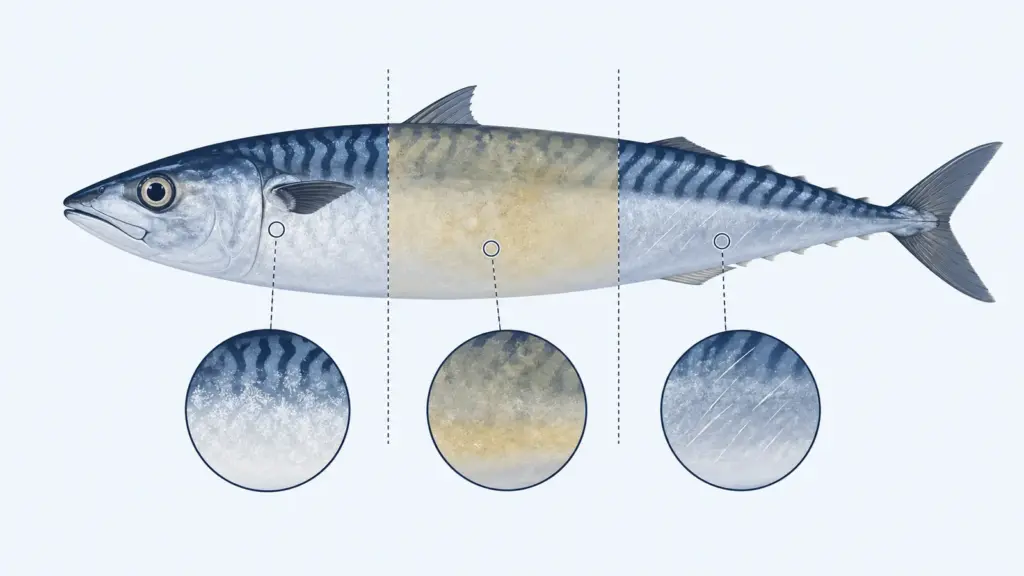
The lot should be read as a pattern, not as a collection of dramatic photographs. Look for freezer burn, dry edges, heavy frost, and exposed surfaces; yellow or brown discoloration, rancid notes, or stale flavor; soft flesh, drip loss, belly damage, broken tails, or scale loss; and weight shortage, irregular size distribution, damaged cartons, or illegible lot labels. Record frequency and location, then compare affected and unaffected units from the same lot. This helps determine whether the condition is associated with a production period, carton type, storage zone, or transport position.
Use one documented examination method. Sampling, thawing, lighting, weighing, sensory description, and temperature measurement should be repeatable. Keep original photographs, logger files, labels, seals, and sample identities. A picture without lot context is weak evidence. The FAO guidance on quality changes during frozen storage can inform the assessment; buyer and seller should still agree on the governing method before shipment.
Link Each Defect to Its Most Likely Process Stage
Freezer burn and surface dryness usually direct attention to glaze, packaging, airflow, and storage duration. Large frost accumulation or fused cartons may point to temperature fluctuation or moisture entry. Belly burst, broken tails, scale loss, and bruising can reflect rough handling, overfilling, or raw-material weakness. Rancid notes require review of fat level, oxygen exposure, storage time, and temperature stability.
The same defect can have several origins, so use a cause-and-evidence table. For each observation, list possible stages, supporting records, and evidence that would contradict the hypothesis. This prevents the team from treating a symptom as a confirmed diagnosis. It also makes corrective action more specific: adjusting a freezing line, improving carton strength, changing glaze control, or correcting warehouse airflow are very different responses.
Test Competing Root-Cause Explanations
Root-cause analysis should test alternatives. Ask what changed, where the change could occur, and which record supports or contradicts each explanation. Production records, freezer performance, packaging controls, warehouse temperatures, reefer data, and receiving practices should form one timeline.
Analytical results are only as strong as the sampling plan and method. Confirm lot identity, sample custody, units, reporting basis, and the correct destination criterion. Repeated testing should not be used to search for a favorable result after a documented control failure. The Codex sensory evaluation guidelines for fish and shellfish is an important reference for the relevant issue.
What Effective Prevention Looks Like
Prevention is stronger than final inspection. A competent operation will classify defects by safety, functionality, and appearance rather than treating every complaint equally; trace each defect to harvest, processing, freezing, storage, or transport stages; keep reference photographs and agreed defect definitions; and use corrective action records to prevent recurrence instead of settling claims without root-cause analysis. Ask to see the records for a normal lot and for a lot that deviated. The difference shows whether the system merely records data or actually controls product.
Audit operators, instruments, calibration, review signatures, hold authority, and corrective-action closure. A current certificate does not replace evidence from the offered process. Importers also need controlled receiving, temperature review, stock rotation, and escalation. The frozen mackerel buying guide can support product selection, while the buyer’s warehouse must maintain the agreed conditions.
Write an Inspectable Purchase Specification
Write defect terminology, sampling plan, tolerance by defect class, thawing method for evaluation, net-weight basis, and photographic evidence requirements into the purchase specification. A number without units, a color requirement without a reference, or a temperature limit without a measurement method cannot be inspected consistently. State who samples, who tests, and who has release authority.
Name the destination and the exact legal, certificate, test, or customer requirement. Then define remedies and evidence: sample retention, logger files, photographs, survey rights, notification timing, and cost allocation. Clear contract mechanics reduce arguments about method after a defect is found.
Practical Checks from Order to Arrival
Before the Purchase Order
Define the product and destination, assess the facility, approve the specification, and agree on tests, certificates, inspection, and change control. Avoid approving an order on quotation language alone.
Before the Container Leaves
Use risk-based sampling across lots and production periods. Verify critical records and outstanding corrective actions. Inspect the reefer, loading pattern, logger identity, seal, and quantity before authorizing shipment.
When the Cargo Arrives
Protect the evidence chain. Save raw temperature data, record carton and product condition, and hold suspect stock. Coordinate independent survey or laboratory work before product is altered or widely distributed.
Questions That Reveal Supplier Capability
Ask where this issue appears in the hazard analysis or quality plan, which step controls it, what limit and monitoring frequency are used, and how instruments are calibrated. Confirm lot traceability, sampling method, laboratory competence, retained samples, deviation disposition, destination requirements, and authority to stop release. Request one recent corrective-action example. Specific records are stronger than undated photographs, generic certificates, or brochure statements.
Conclusion
A reliable frozen mackerel quality problems decision combines specification, representative evidence, process history, and destination requirements. No certificate, photograph, or test should be interpreted in isolation. Clear methods and preserved records protect both product safety and commercial fairness.
Send the supplier the destination, product form, size, glaze and net-weight basis, packing, quality tolerances, certificate list, laboratory plan, and release procedure. To discuss a program, contact the export team with the complete order requirements.
Looking for a Frozen Seafood Supplier?
Contact HANXING SEAFOOD to confirm current availability, specifications, packing, and quotation details.
Request a Quote