
Mackerel vs Horse Mackerel: Why the Name Misleads Import Buyers
Introduction
“Mackerel vs Horse Mackerel” is not a trivial vocabulary exercise. It is a commercial identification challenge that affects pricing, specification accuracy and buyer expectations in frozen seafood trade. A growing number of importers discover this the hard way: they issue an inquiry for “frozen mackerel,” receive a quotation for Trachurus species, and only later realize the product belongs to a different taxonomic family with distinct physical characteristics, market positioning and end-user applications.
The confusion is understandable. The English word “mackerel” appears in both names, and several common commercial terms — jack mackerel, scad, saurel and jurel — further blur the distinction across languages and trading regions. Yet the difference matters at every stage of a transaction: species verification, size grading, processing yield, customs classification, health certification and buyer satisfaction. This article provides a structured import buyer guide covering scientific classification, physical identification, commercial specifications, processing forms, packing standards and the trade risks created by ambiguous naming. Importers sourcing through Hanxing Seafood can use this framework to tighten specifications and avoid costly misunderstandings.
Table of Contents
- Scientific Classification: Scombridae vs Carangidae
- Physical Differences That Matter at Inspection
- Commercial Specifications, Size Grades and Processing Forms
- Market Applications and Buyer Expectations
- Mislabeling Risks and Documentation Controls
- Conclusion
Scientific Classification: Scombridae vs Carangidae
True mackerels belong to the family Scombridae, which also includes tunas and bonitos. The commercially important genera are Scomber — notably Scomber scombrus (Atlantic mackerel) and Scomber japonicus (chub or Pacific mackerel). Horse mackerels belong to the family Carangidae, which encompasses jacks, trevallies, scads and pompanos. The principal genus is Trachurus, with key commercial species including Trachurus trachurus (Atlantic horse mackerel), Trachurus japonicus (Japanese jack mackerel), Trachurus trecae (Cunene horse mackerel) and Trachurus murphyi (Chilean jack mackerel).
The family-level split has practical consequences. Scombridae fish are scombroid species subject to specific histamine controls; Carangidae fish may fall under different regulatory frameworks. A health certificate recording Scomber japonicus for a shipment containing Trachurus japonicus is species misrepresentation that can trigger rejection. The NOAA Atlantic mackerel species profile and FishBase Trachurus japonicus species summary provide authoritative reference data.
Physical Differences That Matter at Inspection
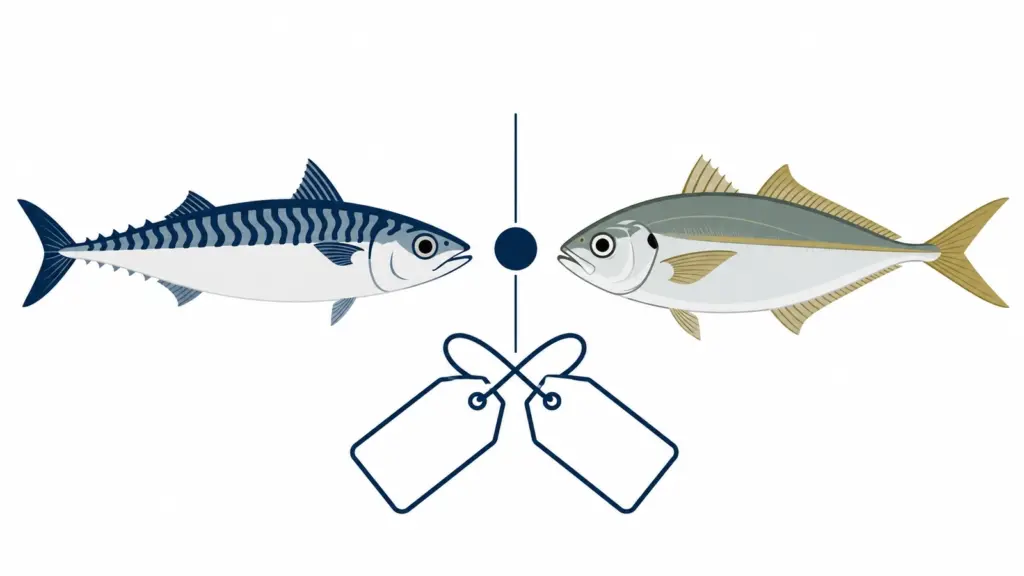
Body profile and head shape. True mackerel have a torpedo-shaped, streamlined body with a pointed snout. Horse mackerel display a deeper, more compressed body profile with a larger head and eye. Dorsal markings. Atlantic mackerel has distinctive wavy black bars across the upper back with a clean silvery-white belly. Horse mackerel generally lacks prominent wavy bars; its coloration tends toward grayish-blue with a characteristic black blotch on the opercular margin. Lateral line and scutes. This is the definitive anatomical difference. True mackerel have a typical lateral line without enlarged armored scales. Horse mackerel possess a prominent lateral line armed with enlarged, keeled scutes forming a visible armored ridge. Fins and finlets. Many Scombridae have small finlets between the second dorsal fin and tail; Trachurus species do not.
Commercial Specifications, Size Grades and Processing Forms
Horse mackerel occupies a distinct position in the frozen seafood product matrix. Compared with true mackerel, horse mackerel typically trades at a lower price point, is more commonly sold in whole-round form, and is frequently directed to African, Middle Eastern and price-sensitive Southeast Asian channels. The FAO small-pelagics market analysis documents these market dynamics.
True mackerel common grades include 100-200g, 200-300g, 300-500g and 500g+. Horse mackerel is generally smaller; common sizes range from 50-100g, 100-200g and occasionally 200g+. Processing forms: true mackerel is traded as WR, H&G, HGT, butterfly cut and fillet; horse mackerel is more commonly WR, though H&G forms are available. Hanxing Seafood’s frozen horse mackerel product page illustrates typical commercial specifications.
Market Applications and Buyer Expectations
True mackerel delivers rich, oily flesh with a distinctive flavor supporting grilling, smoking, canning, salt-curing and high-end sashimi. Horse mackerel has firmer, darker and leaner flesh. It is widely consumed as grilled or fried whole fish in Japan (aji), in Mediterranean cuisines, and as affordable protein in African wholesale markets. Its commercial strength is price accessibility and cultural familiarity, not the fatty premium that drives high-value true mackerel trade. Using Pacific mackerel product specifications alongside horse mackerel references helps build a comparative understanding.
Mislabeling Risks and Documentation Controls
Seafood species mislabeling is a documented risk in international trade, and the mackerel category is particularly exposed. Five-point documentation control: (1) Scientific name as the anchor on every trade document; (2) Separate raw-material origin from processing country; (3) Cross-check commercial name against importing country’s approved list; (4) Verify size grade and processing form against declared species; (5) Retain reference samples and photographs. For additional context, the FAO CECAF small pelagic stock assessment provides regional production data for Northwest African horse mackerel fisheries.
Conclusion
Mackerel vs horse mackerel is ultimately a question of species integrity in frozen seafood trade. The shared English word creates a commercial shortcut that becomes a liability when importers skip scientific verification. The physical difference — visible in body profile, markings, lateral-line scutes and the absence of finlets — confirms what taxonomy already states: these are different families with different commercial profiles. Importers who treat species identity as a non-negotiable specification field protect downstream customers, reduce customs exposure, and build supplier relationships grounded in accurate documentation.
Contact Hanxing Seafood today at sales@hanxingseafood.com or visit www.hanxingseafood.com to discuss your frozen mackerel and horse mackerel sourcing requirements.
Looking for a Frozen Seafood Supplier?
Contact HANXING SEAFOOD to confirm current availability, specifications, packing, and quotation details.
Request a Quote