
How to Identify Mackerel Species by Appearance: A Visual Guide for Seafood Quality Inspectors
Introduction
Accurate mackerel species identification is a critical competency in the frozen seafood supply chain. Containers routinely arrive at ports labeled with species names that do not match their contents, whether through sorting errors or deliberate substitution. For importers and QA teams, the ability to verify species identity through visual inspection before customs clearance is a financial safeguard, a regulatory requirement, and a cornerstone of buyer-supplier trust. Hanxing Seafood, as a specialized supplier of premium frozen Pacific mackerel, has developed rigorous identification protocols that inform this guide. Drawing on NOAA, FAO, and FishBase reference data, this article provides B2B buyers a practical framework for visual species authentication.
Table of Contents
- Body Shape and Morphometric Differences
- Coloration and Dorsal Markings by Species
- Fin Structure and Meristic Identifiers
- Size Ranges, Frozen-State Challenges, and Common Substitution Patterns
- Quality Inspection Checklist for Importers
- Conclusion
Body Shape and Morphometric Differences
All Scomber species share a torpedo-shaped body plan, but differences in body depth and head profile enable initial species determination at a glance.
Pacific chub mackerel (Scomber japonicus) has a moderately deep body with depth fitting 3.8 to 4.2 times into fork length, a relatively large head at 26 to 29 percent of standard length, and gradual taper toward the caudal peduncle. Hanxing Seafood’s detailed Pacific mackerel specifications provide additional morphometric reference data.
Atlantic mackerel (Scomber scombrus) is noticeably more slender, with body depth fitting 4.2 to 4.8 times into fork length and a smaller head at 23 to 26 percent of standard length. The lower jaw projects slightly beyond the upper — a feature NOAA Fisheries documents as a key identifier — and the narrower caudal peduncle accentuates a streamlined silhouette.
Blue mackerel (Scomber australasicus) has body depth ratios of 3.9 to 4.4 times fork length, overlapping significantly with S. japonicus — making dorsal patterns and fin-ray counts essential for Western Pacific shipments, per FishBase.
Atlantic chub mackerel (Scomber colias) closely resembles S. japonicus with body depth ratios of 3.7 to 4.1 times fork length. The most reliable separator is eye diameter, larger relative to head length in S. colias (orbit 4.5–5.2 times in head length) than in S. japonicus (5.0–5.8 times).
Coloration and Dorsal Markings by Species
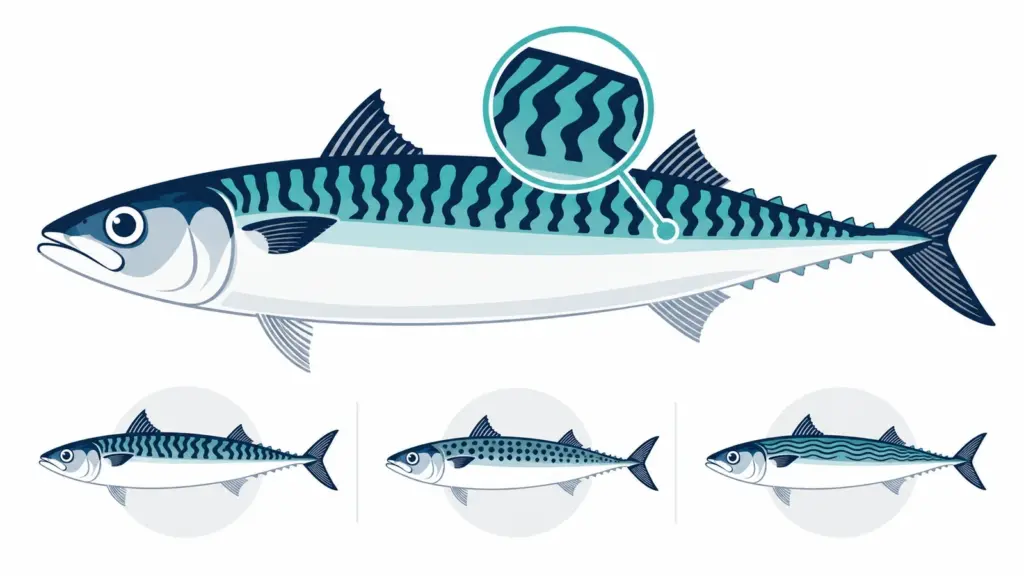
Dorsal markings are the most accessible identification feature in a cold-store environment. Background color, marking shape, and ventral pattern are species-diagnostic when evaluated together.
Pacific chub mackerel displays a deep metallic blue-green dorsum overlaid with 24 to 33 dark, wavy transverse bands extending to roughly one-third of body depth. These bands are broad, sinuous, and frequently bifurcate, creating a reticulated appearance — see the FAO fact sheet for Scomber japonicus for reference photographs. The belly is white; inconsistent dark spotting below the banded zone may occur but is unreliable as a primary identifier.
Atlantic mackerel bears 23 to 30 dark bands that are straighter, narrower, and more crisply defined, rarely bifurcating and extending only to about one-quarter of body depth. The belly is uniformly silvery-white with no markings — a useful negative indicator.
Blue mackerel features brilliant blue-green coloration with narrow, wavy lines more reticulated than either S. japonicus or S. scombrus. The belly is unmarked silvery-white. Blue iridescence fades rapidly post-mortem, so inspectors should not rely on color intensity in frozen product. For species-specific grading parameters, refer to Hanxing Seafood’s frozen mackerel specifications.
Atlantic chub mackerel closely mirrors S. japonicus with 24 to 30 wavy interconnected bands. Subtle differences are insufficiently reliable alone, making multi-character assessment essential.
Fin Structure and Meristic Identifiers
Fin structure provides the most objective characters for mackerel species identification. All Scomber species possess two dorsal fins separated by a narrow interspace; diagnostic parameters are first dorsal fin (D1) spine count, second dorsal fin (D2) ray count, and finlet numbers.
| Species | D1 Spines | D2 Soft Rays | Dorsal Finlets | Anal Finlets |
|---|---|---|---|---|
| S. japonicus (Pacific chub) | 9–10 | 11–12 | 5 | 5 |
| S. scombrus (Atlantic) | 11–13 | 11–13 | 5 | 5 |
| S. australasicus (Blue) | 10–13 | 11–12 | 5 | 5 |
| S. colias (Atlantic chub) | 9–12 | 11–13 | 5 | 5 |
Sources: NOAA Fisheries; FAO; FishBase.
The most powerful discriminator is D1 spine count: Atlantic mackerel consistently has 11 to 13 spines, whereas Pacific chub mackerel carries 9 to 10. Blue and Atlantic chub mackerel overlap with both, so spine count must be combined with body-shape and marking evidence. D1 counts can be performed on frozen product by gently flexing the fin with a blunt probe — spines remain palpable even frozen.
Size Ranges, Frozen-State Challenges, and Common Substitution Patterns
Size Ranges
Size alone is not definitive, but commercial size ranges provide a useful framework for flagging mismatches.
| Species | Typical Commercial Size (FL) | Maximum Recorded |
|---|---|---|
| S. japonicus | 25–40 cm | ~64 cm |
| S. scombrus | 25–50 cm | ~66 cm |
| S. australasicus | 22–35 cm | ~49 cm |
| S. colias | 25–45 cm | ~65 cm |
If a container declared as Atlantic mackerel contains only sub-30 cm specimens from a Pacific-region port, closer inspection is warranted. The NOAA Pacific Chub Mackerel directory provides additional size-at-maturity reference data.
Frozen-State Challenges
Freezing degrades dorsal iridescence; banding patterns persist longer than background color, but severe freezer burn can erase contrast entirely. Ice crystal formation distorts body proportions — body-depth ratios from partially thawed specimens require wider tolerance bands. Inspect at least 10 to 15 specimens per sampling unit, as dorsal fin spines are frequently damaged during handling. Water glaze obscures surface detail; rinse a subsample under cold water for 30 to 60 seconds to restore marking visibility without full thawing.
Common Substitution Patterns
Three patterns recur frequently in international trade:
Blue mackerel sold as Pacific chub mackerel. Blue mackerel commands a lower price due to smaller size and softer texture. Its morphological overlap with S. japonicus makes it the most common substitution from Western and South Pacific fisheries; combined D1 spine count and dorsal banding assessment provides the best discrimination.
Atlantic chub mackerel sold as Atlantic mackerel. These species share the Atlantic basin but differ in market value. Eye-diameter ratio and body-depth ratio are the strongest discriminators.
Mixed-species loads. Unintentional admixture occurs in multi-species purse-seine fisheries. A 5 to 10 percent admixture rate may be contractually acceptable; higher rates should trigger a formal nonconformity report. For importers seeking single-species integrity, Hanxing Seafood’s about us page details the quality control processes that eliminate mixed-species contamination at origin.
Quality Inspection Checklist for Importers
The following workflow is suitable for cold-store receiving, port-side audits, and pre-shipment verifications.
Pre-inspection: Confirm declared species and FAO fishing zone from shipping documents. Prepare digital calipers, headlamp, blunt probe, magnifying lens, and camera.
Sampling: Draw 10 to 15 random whole-round specimens per lot; for lots over 1,000 cartons, follow ISO 2859-1 level I. Rinse glaze with cold water for 30 to 60 seconds without fully thawing.
Visual checks — apply all criteria:
- Body shape: Slender (4.2–4.8x fork length) suggests Atlantic mackerel; deeper (3.8–4.2x) suggests chub mackerel.
- Dorsal banding: Straight, narrow, non-branching bands suggest Atlantic mackerel; wavy, broad, branching bands suggest chub mackerel.
- D1 spine count: 11–13 strongly indicates Atlantic mackerel; 9–10 is consistent with Pacific chub mackerel.
- Belly pattern: Unmarked white belly supports Atlantic or blue mackerel; spotting below the banded zone supports chub mackerel.
- Eye diameter (if intact): Larger eye (orbit less than 5.2x in head length) favors S. colias over S. japonicus.
- Size consistency: Compare observed range against the declared species’ commercial bracket; flag outliers.
Documentation: Photograph specimens and record all measurements. If all characters align, clear the lot. If any is inconsistent, escalate to a 30-specimen confirmation sample and quarantine if sustained.
Conclusion
Mackerel species identification protects B2B buyers from financial loss, regulatory exposure, and reputational damage. The multi-character framework presented here — body shape, dorsal banding, fin-ray counts, and size-range context — performs reliably under frozen-product conditions. Convergent evidence from multiple character systems yields accurate, defensible determinations. For importers who value certainty, sourcing from suppliers with in-line species verification at the point of production is the most effective strategy. Hanxing Seafood’s Pacific mackerel program exemplifies this approach; further information is available on the FAQ page.
Contact Hanxing Seafood today at sales@hanxingseafood.com or visit www.hanxingseafood.com to discuss mackerel quality specifications and product verification.
Looking for a Frozen Seafood Supplier?
Contact HANXING SEAFOOD to confirm current availability, specifications, packing, and quotation details.
Request a Quote