
Chub Mackerel vs Pacific Mackerel: Is There Really a Difference for Importers?
Introduction
A container of frozen mackerel arrives at port. The commercial invoice reads “Pacific mackerel, Scomber japonicus.” The health certificate declares “Chub mackerel, Scomber japonicus.” A documentation clerk flags the discrepancy. The shipment sits in cold storage for three days while emails circulate — all because no one explained that chub mackerel and Pacific mackerel are the same fish.
For B2B seafood buyers, this scenario is frustratingly common. The naming question generates more confusion in frozen seafood trade documentation than almost any other pelagic species pair. Understanding why the confusion exists, where each name is used, and how to prevent documentation disruption is essential knowledge.
This article resolves the chub vs Pacific mackerel naming question definitively, examining the scientific basis for the naming split, regional conventions across key markets, the separate Atlantic chub mackerel issue, and a practical documentation protocol for importers.
Table of Contents
- One Species, Two Names: The Scientific Reality
- Regional Naming Conventions Across Major Markets
- Atlantic Chub Mackerel: The Separate Species That Compounds the Confusion
- Documentation Protocol for Importers
- Conclusion
One Species, Two Names: The Scientific Reality
The foundational fact must be stated clearly: chub mackerel and Pacific mackerel both refer to Scomber japonicus, a single species within the genus Scomber. FishBase lists the FAO standard English name as “Chub mackerel,” and the Integrated Taxonomic Information System confirms Scomber japonicus as the accepted scientific name with no subspecies division that would support a separate “Pacific mackerel” taxon.
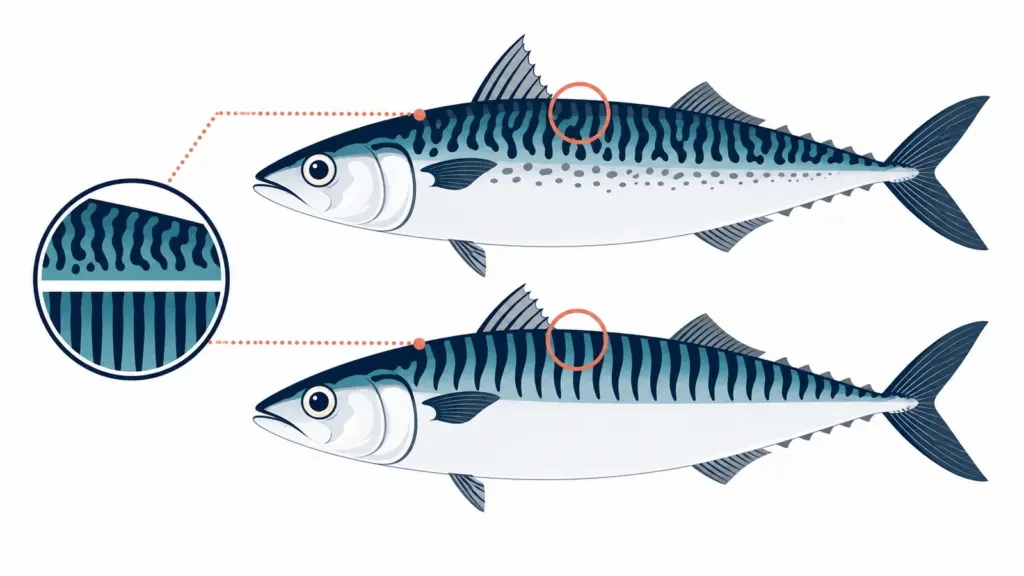
Morphologically, Scomber japonicus reaches approximately 64 centimeters maximum fork length, with commercial catches typically 20 to 40 centimeters. The species has 9 to 13 dorsal spines, a swim bladder that is absent (unlike Scomber australasicus), and dark wavy bands across the dorsal surface. Its global distribution spans warm and temperate waters of the Pacific, Atlantic, and Indian Oceans, with major stocks in the Northwest Pacific, Northeast Pacific, and historically the Southeast Pacific.
Why do two names persist for one fish? For decades, some authorities classified Pacific and Atlantic populations separately — Scomber japonicus in the Pacific and Scomber colias in the Atlantic. When genetic evidence confirmed many populations were conspecific, naming conventions lagged behind the science. The FAO species profile now recognizes Scomber japonicus as “Chub mackerel” globally, while acknowledging the regional preference for “Pacific mackerel” in North American fisheries management.
Regional Naming Conventions Across Major Markets
The two-name phenomenon follows distinct geographic patterns that importers must recognize when reading trade documents from different origins.
In the United States and Canada, the preferred name is “Pacific mackerel.” NOAA Fisheries manages the West Coast stock under this name, and the Pacific Fishery Management Council uses it for catch reports and quota announcements. Many American buyers encountering “chub mackerel” on Asian supplier documents assume it refers to a different species — a recurring source of avoidable customs inquiry.
The FAO, by contrast, uses “Chub mackerel” as the official English name in its species fact sheets, fishery statistics, and global trade reporting. FAO catch data attributes all landings of Scomber japonicus to “Chub mackerel” regardless of national naming. Importers moving product between markets must ensure internal systems and customs brokers recognize both names as synonymous. Hanxing Seafood maintains dedicated frozen mackerel specifications using scientific naming alongside trade names to eliminate ambiguity.
In Northwest Pacific production regions, domestic names differ from both English variants. Japanese buyers use masaba, Korean markets use godeung-eo, and Chinese trade refers to tai yu or qingzhan yu. Asian exporters serving international markets typically adopt “Chub mackerel” in English documentation, aligning with FAO convention. If your internal system uses “Pacific mackerel,” establish a cross-reference protocol so receiving staff and customs brokers treat both names as equivalent. Explore Hanxing Seafood’s Pacific Mackerel product page for sourcing across the species range.
Atlantic Chub Mackerel: The Separate Species That Compounds the Confusion
A secondary complexity arises from Scomber colias, the Atlantic chub mackerel — a genetically distinct species that shares “chub” in its name but is not Scomber japonicus.
Scomber colias inhabits the warm temperate and tropical Atlantic, Mediterranean, and Black Sea, from the Bay of Biscay to South Africa on the eastern side and Nova Scotia to Argentina in the west. NOAA Fisheries manages the U.S. Atlantic population under the “Atlantic chub mackerel” designation. The species is distinguished from S. japonicus by subtle haemal spine and gill raker differences — requiring laboratory examination, making visual identification unreliable at inspection.
The commercial consequence: an importer sourcing “chub mackerel” from a Mediterranean supplier may receive Scomber colias, while a Japanese shipment of “chub mackerel” delivers Scomber japonicus. Both invoices legitimately read “chub mackerel,” but the species — with different fat content, size, and market positioning — are not the same product. Atlantic chub mackerel generally commands lower market value, reflecting smaller average size and less established export infrastructure.
For importers navigating these distinctions, the Hanxing Seafood blog offers additional resources on mackerel species identification, and the About Us page details species verification protocols integrated into every export shipment.
Documentation Protocol for Importers
Translating naming clarity into practical workflow eliminates documentation risk at its source.
Adopt a scientific-name-first standard. Every purchase order and inventory record should use Scomber japonicus as the primary identifier, with the common name as a supplementary field. This eliminates ambiguity regardless of which commercial name suppliers use. In purchase contracts, specify: “Frozen whole round Scomber japonicus (chub mackerel / Pacific mackerel), 200-300g, 10kg block.” This works under any destination-market naming convention.
Cross-reference documents before shipment. Verify species identification consistency across the commercial invoice, packing list, health certificate, certificate of origin, and bill of lading. If documents use different common names for the same species, add a short clarification referencing the ITIS Scomber japonicus record or FishBase species summary — most customs authorities accept this without requiring document reissuance.
Educate teams and brokers. The most preventable delays occur when staff flag a name difference that is not actually a discrepancy. Distribute a reference sheet listing Scomber japonicus and its accepted names by market (chub mackerel, Pacific mackerel, masaba, godeung-eo, tai yu) to receiving teams and customs brokers.
Know destination-market preferences. U.S. CBP accepts “Pacific mackerel,” EU authorities generally expect “chub mackerel” following FAO convention, and other markets vary. Verify the destination’s preferred name with a local customs broker and use it in English documentation while always retaining the scientific binomial as definitive.
Conclusion
The chub versus Pacific mackerel naming question has a one-sentence answer: they are the same species, Scomber japonicus, called by different names in different institutional and regional contexts. The two names persist not from scientific ambiguity but because fisheries agencies adopted different conventions before taxonomic consensus settled, embedding both names in regulations and market expectations.
For B2B importers, the takeaway is practical: treat the names as synonyms to manage rather than a problem to solve. Adopt scientific-name-first documentation. Cross-reference trade documents before shipment. Educate teams that Scomber japonicus equals chub mackerel equals Pacific mackerel. And when sourcing from both Atlantic and Pacific origins, verify whether the species is Scomber japonicus or Scomber colias — because “chub mackerel” alone does not distinguish them.
Mastering this one naming convention eliminates a recurring customs friction point, strengthens supplier relationships, and lets importers focus on product quality and competitive pricing.
Contact Hanxing Seafood today at sales@hanxingseafood.com or visit www.hanxingseafood.com to discuss chub mackerel specifications and product requirements.
Looking for a Frozen Seafood Supplier?
Contact HANXING SEAFOOD to confirm current availability, specifications, packing, and quotation details.
Request a Quote