
Global Frozen Mackerel Trade Flows: Main Exporters and Importers
Introduction
Understanding global frozen mackerel trade has become a priority issue for seafood importers, wholesalers, processors, and foodservice distributors because supply decisions made in one fishing region can quickly change prices and availability in distant markets. Trade flows reflect more than the location of fishing vessels. They also reflect processing capacity, tariffs, cold storage, consumer demand, and the ability to move reefer containers reliably. Buyers reviewing the frozen mackerel buying guide should therefore connect product specifications with quota conditions, regional demand, exchange rates, and cold-chain costs rather than treating the quoted price as an isolated number.
global frozen mackerel trade: Current Market Context
The FAO 2026 trade of aquatic products review reports that global trade in aquatic products reached USD 186 billion in 2024. The FAO GLOBEFISH analysis of Asian small pelagic trade documents strong Asian mackerel imports and changing routes through Viet Nam and China, while the FAO GLOBEFISH small pelagics market analysis tracks market developments across mackerel, herring, and sardine. The UNCTAD Review of Maritime Transport 2025 provides the transport context for these long-distance refrigerated flows.
Country rankings can change by year and by HS code, and generic frozen-fish classifications may include several species. A practical trade-flow analysis therefore focuses on origin groups, destination functions, and routes rather than presenting unsupported precise rankings. The broader 2026 global frozen seafood market overview is useful for comparing mackerel with other frozen seafood categories, but purchase decisions still need species-level analysis because Atlantic mackerel, Pacific mackerel, horse mackerel, herring, and sardine do not move in perfect alignment.
North Atlantic Export Origins
Norway, the United Kingdom, Iceland, the Faroe Islands, and other Northeast Atlantic participants are central to Atlantic mackerel supply. Export availability depends on quota decisions, catches, domestic processing, and bilateral access arrangements.
Importers buying Atlantic origin should confirm catch area, origin documents, production season, and whether the supplier’s quantity is secured. Coastal-state management uncertainty can affect expectations even before fishing begins.
Pacific Supply and Processing Origins
China, Japan, Korea, and other Pacific countries participate through catches, imports, processing, and re-export. Pacific mackerel can serve value-oriented and processing markets, while China and Viet Nam also process imported Atlantic material.
The label ‘exported from’ does not always equal ‘caught in.’ Buyers should separate country of catch, country of processing, and country of export to meet customs, labeling, and customer requirements.
Asia as the Largest Regional Market
Asia combines direct consumption, premium retail, large processing industries, and re-export. Korea and Japan remain important for Norwegian mackerel, while Viet Nam, China, Thailand, and Indonesia support diverse demand.
Trade routes can shift when tariffs or processing costs change. Importers should compare direct and indirect supply chains but ensure that every transformation is documented and permitted by destination regulations.
Africa and the Middle East as Whole-Fish Markets
Many African and Middle Eastern importers buy frozen whole fish for wholesale, traditional retail, and foodservice. Price sensitivity is high, and buyers may switch among Atlantic mackerel, Pacific mackerel, horse mackerel, scad, and sardine.
Suppliers should match carton size, fish size, glazing, and payment terms to local distribution. The lowest-cost origin is not always competitive after freight, duty, storage, and customer preferences are included.
Processing Hubs Reshape Apparent Trade
A country can appear as a major importer because it processes and re-exports fish rather than consuming the entire volume domestically. This is particularly relevant in Asian trade, where raw material can cross several borders before final sale.
Companies should track the full chain of custody. Health certificates, origin documents, processing-establishment approval, tariff classification, and labeling must remain consistent with the final destination’s rules.
Procurement Priorities for Importers
For buyers assessing global frozen mackerel trade, commercial discipline is as important as market intelligence.
Importers should convert market analysis into a written procurement plan. The most important actions for this topic are to separate catch, processing, and export origins; use current HS-code data carefully; compare direct and processed trade routes; verify reefer transit and transshipment; maintain alternative origin options. These controls reduce the risk of comparing offers that use different species, size bands, glazing levels, processing forms, currencies, shipment windows, or documentary assumptions. A lower headline price can become more expensive after yield loss, repacking, storage, financing, or delayed delivery is included.
Product substitution should also be tested against the final sales channel. Buyers can compare the available frozen seafood product range and request samples or loading references before changing a specification. Retail buyers may prioritize appearance and uniform sizing, processors may focus on yield and fat content, while traditional wholesale markets may accept broader tolerances when the landed cost is competitive. The correct specification is therefore the one that protects the buyer’s margin and customer acceptance, not simply the product with the lowest FOB value.
Market Outlook and Risk Indicators
Global frozen mackerel trade will remain dynamic as lower Atlantic supply, Asian processing, tariffs, and freight reshape routes. Total demand may remain resilient even when one origin loses volume, because buyers can change species, processing location, or source country. The practical approach is to monitor scientific advice, final national quotas, auction prices, export volumes, currency movements, and freight quotations as separate indicators. A change in only one indicator may be temporary, while several indicators moving in the same direction usually signal a more durable market shift.
Buyers should maintain at least a base case, a tight-supply case, and a substitution case. The base case assumes ordinary seasonal demand and workable freight capacity; the tight-supply case assumes lower raw-material availability or stronger competition; and the substitution case identifies alternative species and sizes that can protect volume. This scenario discipline is more reliable than depending on a single price forecast.
Conclusion
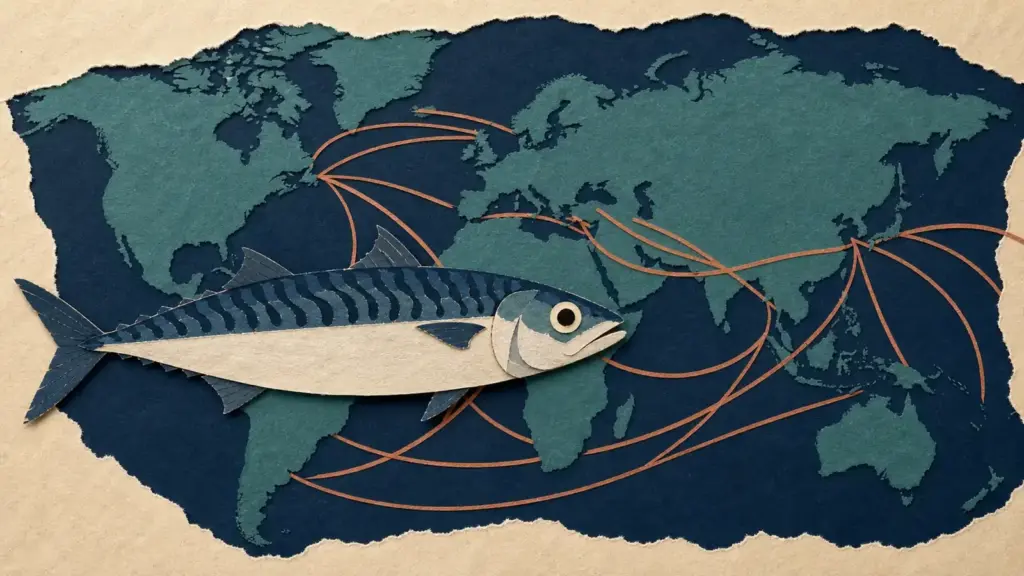
The global market is a network rather than a simple exporter-to-importer ranking. Companies that understand where fish is caught, processed, financed, and consumed can identify supply risks and opportunities earlier. This analysis of global frozen mackerel trade should be reviewed as part of a complete landed-cost and supply-risk assessment. Importers that confirm species, specification, packing, loading window, documents, and contingency options before signing a contract are better positioned to protect margins during volatile periods.
Hanxing Seafood supports international buyers with product selection, packing discussions, export documentation coordination, and shipment planning. To discuss current availability or request a market-specific quotation, contact the Hanxing Seafood sales team.
Looking for a Frozen Seafood Supplier?
Contact HANXING SEAFOOD to confirm current availability, specifications, packing, and quotation details.
Request a Quote